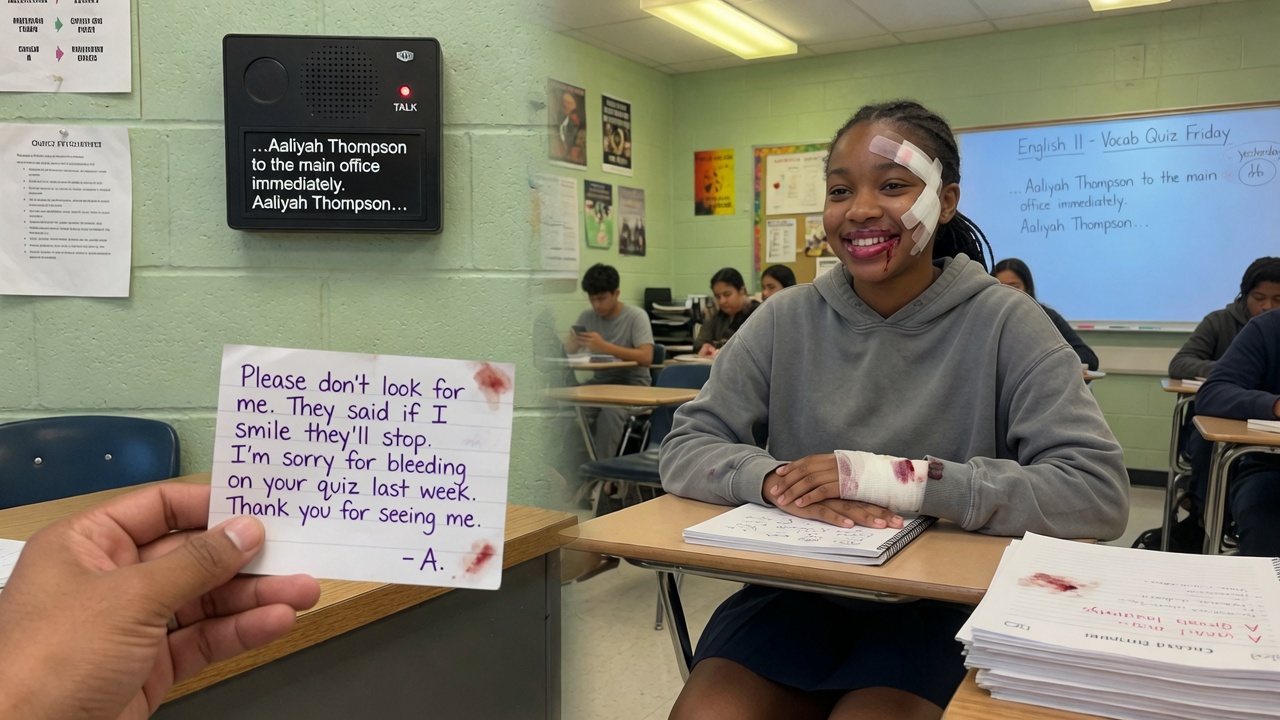
The purple-yellow fingerprint bruises on Maya’s forearm were so fresh they looked like watercolor paint against her pale skin, but it was the bright, dead smile she gave me when the intercom buzzed that made the blood freeze in my veins.
I’ve been teaching high school English for twelve years, and you learn quickly that there are two types of quiet kids.
There are the ones who are simply shy, the ones who would rather melt into their chairs than read a paragraph aloud.
Then, there are the ones who are quiet because they are surviving.
Maya Vance belonged to the second category, and I knew it from the first week of September.
She was sixteen, a junior at Oakridge High, a school nestled in a wealthy American suburb where the biggest scandals usually involved slashed tires or underage drinking at a country club.
Oakridge was a place of manicured lawns, luxury SUVs in the student parking lot, and parents who aggressively emailed teachers over a B-minus.
It was a place where bad things simply weren’t supposed to happen.
But I knew better. I knew that the highest fences hide the darkest secrets.
Maya was a ghost in my third-period AP Literature class. She sat in the back row, near the window, always angled slightly toward the door as if mapping her escape route.
She was small for her age, drowning in oversized, heavy vintage sweaters even when the early autumn heat pushed the classroom temperature to eighty degrees.
I never pushed her to speak. I let her turn in her participation assignments on paper.
Her essays were brilliant, sharp, and deeply unsettling.
When we read Mary Shelley’s Frankenstein, the other students wrote about the dangers of unchecked scientific ambition.
Maya wrote a ten-page analysis on the monster’s tragic realization that his creator was capable of profound, unprovoked cruelty.
“The true horror of the creature’s existence,” she had written in her neat, precise cursive, “is not that he is a monster, but that he was forced to learn monstrousness from the very hands that were supposed to care for him.”
I had given her an A-plus, but reading those words had left a cold pit in my stomach.
It reminded me too much of Leo.
Leo Ramirez was my old wound. The kind of wound that never fully closes, the kind that flares up at 3:00 AM when the house is entirely silent.
Five years ago, Leo had been a sophomore in my homeroom. He was a funny, bright kid who started showing up with split lips and faint, greenish marks on his jawline.
When I pulled him aside to ask what happened, he flashed me a goofy grin and blamed his skateboard. “Just tried a kickflip down the bleachers, Mr. Thorne. Total fail,” he’d laughed.
I believed him. Or rather, I chose to believe him because it was easier than initiating the bureaucratic nightmare of a Child Protective Services report.
Two days after that conversation, Leo was admitted to the county ICU with a ruptured spleen and a fractured orbital bone.
His stepfather had beaten him with a steel pipe in their garage.
I still remember standing in the sterile, blindingly white hallway of the hospital, listening to the rhythmic, terrifying beep of his life support machine.
I remember the way the school administration scrambled to cover their tracks, holding endless meetings about “liability” rather than the kid fighting for his life in a hospital bed.
Leo survived, but he never came back to Oakridge. His mother moved them across the country, running from the mess, and I was left with a guilt so heavy it permanently altered the way I looked at my students.
I swore on my life that day: I would never look away again. I would never let another kid slip through the cracks just because the truth was inconvenient.
Which brings me to this morning. A Friday in late October.
The classroom smelled faintly of floor wax and the cheap vanilla perfume the cheerleaders sprayed between periods.
I was standing at the whiteboard, dissecting the themes of isolation in To Kill a Mockingbird. The class was mostly asleep, hypnotized by the hum of the fluorescent lights.
Maya was in her usual spot, her head bowed over her desk.
But something was wrong.
Usually, Maya was perfectly still. Today, she was vibrating. Her left knee bounced against the metal desk leg in a frantic, erratic rhythm.
She was clutching her pen so tightly her knuckles were stark white.
And then, she reached up to push a strand of dark hair behind her ear, and the oversized sleeve of her gray wool sweater slipped down just a few inches.
I stopped mid-sentence. My voice caught in my throat.
Just above her wrist, extending up her forearm, were three distinct, oval-shaped contusions. Deep purple at the center, fading to a sickly, jaundiced yellow at the edges.
They were fingerprints. The unmistakable, brutal grip of an adult hand that had clamped down with enough force to burst blood vessels.
The silence in the room stretched. Twenty-five pairs of teenage eyes shifted from the whiteboard to me, waiting for me to finish my thought on Boo Radley.
“Uh,” I stammered, my heart suddenly hammering against my ribs. “As I was saying… isolation can be both a prison and a sanctuary.”
I looked back at Maya. She had realized the sleeve slipped.
She violently yanked the wool fabric back down, her eyes darting up to meet mine.
For a fraction of a second, the mask slipped. I saw raw, unadulterated terror in her dark brown eyes. The kind of terror you see in a trapped animal that hears the snap of a twig in the dark.
I took a slow breath, trying to steady my racing pulse. I needed to wait until the bell rang. I needed to pull her aside. I needed to call Sarah Jenkins, our school counselor, and lock the door until CPS arrived.
I had a plan. I was going to do it right this time.
And then, the intercom on the wall crackled to life with a sharp, electric buzz that made half the class jump.
“Pardon the interruption,” the flat, bureaucratic voice of the front office secretary echoed through the room. “Mr. Thorne, please send Maya Vance to the main office for early dismissal. Her father is here to sign her out.”
The word father dropped into the quiet classroom like a live grenade.
I felt the blood drain from my face. I looked instantly at Maya.
The erratic bouncing of her knee stopped abruptly. Her entire body went rigid, as if an invisible current of electricity had just paralyzed her spine.
“Her father?” I asked the plastic speaker on the wall, my voice sounding incredibly hollow. “She’s… we’re in the middle of a major exam prep. Can he wait until the period ends?”
It was a desperate, stupid stall tactic.
“No, Mr. Thorne,” the secretary replied, sounding annoyed. “Mr. Vance has a family emergency. Please send her down immediately.”
The intercom clicked off. The silence rushed back into the room.
All eyes were on Maya now.
Slowly, she stood up. The terror I had seen in her eyes just moments before had been completely wiped away.
In its place was a chilling, perfectly constructed smile.
It was a smile that didn’t reach her eyes. It was the terrifying, placating smile of someone who knows exactly what will happen to them if they show even an ounce of resistance.
She meticulously gathered her notebooks, stacking them with mechanical precision. She hoisted her backpack over her shoulder.
As she walked down the aisle toward the front of the room, the class went back to staring at their phones or doodling in their notebooks, utterly oblivious to the psychological horror unfolding right in front of them.
She stopped at my desk.
“Have a wonderful weekend, Mr. Thorne,” she said. Her voice was light, airy, and entirely devoid of emotion.
“Maya,” I said, my voice barely a whisper. I stood up, leaning over my desk. “Are you okay? Do you want me to walk down with you?”
“I’m perfectly fine,” she said, her smile widening just a fraction. It looked painful.
As she spoke, she reached out as if to hand me her reading log for the week. But it wasn’t her reading log.
It was a small, tightly folded square of lined notebook paper.
She pressed it directly into the palm of my hand. Her fingers were ice-cold.
Before I could say another word, she turned and walked out the door, her oversized sweater swallowing her small frame as she disappeared into the empty hallway.
I stood paralyzed for three agonizing seconds.
The piece of paper felt incredibly heavy in my hand, burning against my skin.
“Read Chapter 12 silently,” I barked at the class, my voice cracking slightly. “Nobody talk. Nobody move.”
I didn’t wait to see if they obeyed. I dropped back into my desk chair and with trembling fingers, I unfolded the small square of paper.
The handwriting was frantic, jagged, completely unlike her usual perfect cursive. It was written in thick, black ink that looked like it had been pressed into the paper so hard it nearly tore through.
Don’t let me get in that truck. He knows I told the school nurse about the lock on my door. If I leave this building with him today, I will not survive the weekend. Please. You’re the only one who looks at me.
I stopped breathing.
The walls of the classroom felt like they were rapidly closing in, crushing the oxygen out of my lungs.
I will not survive the weekend.
The ghost of Leo Ramirez screamed in my ear. The memory of the life support monitor beeped frantically in the back of my mind.
I shoved the note into my slacks pocket, grabbed my master keys, and sprinted out of the classroom.
I didn’t care about the twenty-five unsupervised teenagers I left behind. I didn’t care about school protocol or my job security.
I ran down the linoleum hallway, my dress shoes loudly slapping against the floor, dodging a custodian pushing a mop bucket.
I burst through the heavy wooden door of the Guidance Department without knocking.
Sarah Jenkins was sitting at her desk, entirely surrounded by towering stacks of college applications and color-coded file folders.
Sarah was forty-five, fiercely intelligent, and deeply burned out. She practically ran the emotional welfare of the school single-handedly.
She was a recovering alcoholic, fourteen years sober, a detail she used to connect with the most troubled kids. It gave her an edge—a cynical, no-nonsense grit that cut through the polite, suburban bullshit of Oakridge High.
Her office always smelled like dried lavender and stale espresso, a desperate combination of calm and frantic energy.
She looked up from her computer monitor, startled by my violent entrance. She was chewing furiously on the end of a blue ballpoint pen, a habit she leaned into when she was stressed.
“Jesus, Elias,” she sighed, dropping the cracked plastic pen onto her desk. “You look like you just saw a corpse. What happened? Did a sophomore plagiarize Wikipedia again?”
“Maya Vance,” I choked out, slamming the door shut behind me and locking the deadbolt.
Sarah’s demeanor changed instantly. The sarcasm vanished. Her spine straightened, and she leaned forward, her dark eyes locking onto mine.
She knew. Sarah always knew which kids were walking on the razor’s edge.
“What about her?” Sarah asked, her voice dropping an octave.
I pulled the crumpled note out of my pocket and flattened it onto her desk, directly over a stack of pristine Harvard brochures.
Sarah read the jagged black ink. I watched her jaw clench tightly. Her eyes scanned the four lines of text once, twice, three times.
“Where is she right now?” Sarah asked, her voice dangerously calm. It was the tone of a soldier assessing a battlefield.
“The front office,” I breathed, running a trembling hand through my hair. “Her stepfather just came to sign her out. The intercom called her down three minutes ago.”
Sarah swore viciously under her breath, a sharp, ugly word that didn’t belong in a school building. She pushed her chair back so violently it slammed against the filing cabinet behind her.
“Richard Vance is here?” Sarah demanded, grabbing her desk phone.
“Yes. She showed up to class with bruising on her forearm. Fingerprints, Sarah. Clear as day. She tried to hide them, but the sleeve slipped.” I was pacing now, my heart hammering against my ribs like a trapped bird. “He knows she talked to the nurse. He’s pulling her out to punish her. If she gets in his truck—”
“I know,” Sarah interrupted sharply, holding her hand up. “I know, Elias. The nurse, Mrs. Gable, came to me at 8:00 AM this morning. Maya told her last week that her stepfather installed a deadbolt on the outside of her bedroom door.”
I stopped pacing. The blood ran cold in my veins. “A deadbolt on the outside?”
“Yes,” Sarah said, her fingers flying across her keyboard, pulling up Maya’s digital file. “I’ve been trying to get CPS on the phone for the last hour, but the caseworker assigned to our district is on leave, and the emergency hotline put me on a forty-minute hold.”
“So we stop him,” I said, stepping toward her desk. “We walk down there right now, and we physically stop him from taking her.”
Sarah looked up at me, her eyes filled with a helpless, infuriating rage. She looked incredibly tired in that moment, the weight of a thousand broken kids pressing down on her shoulders.
“Elias, you know the law,” she said quietly, the words tasting like ash in her mouth. “Richard Vance has full legal custody. Maya’s biological mother died three years ago. There is no active police report. There is no restraining order. Until CPS formally opens an investigation and gets a judge to grant temporary protective custody, Richard has every legal right to walk into this building and take his daughter home.”
“Legal right?” I exploded, my voice cracking with disbelief and fury. “I just handed you a suicide note! Or a murder prediction! It’s right there in black and white!”
“I know!” Sarah yelled back, matching my volume, standing up from her desk. “Do you think I want to let him take her? But if we physically barricade a legal guardian from taking his child without a police order, we will be arrested for false imprisonment and kidnapping, Elias! And then we both lose our licenses, and we can’t help Maya or any other kid in this building!”
“I don’t give a damn about my license!” I shouted, slamming my fist onto the top of her filing cabinet. The metal boomed loudly in the small office. “I didn’t stop it with Leo, Sarah! I am not doing it again! I am not going to a funeral because Oakridge High wanted to follow protocol!”
The mention of Leo sucked the air out of the room.
Sarah stared at me. She knew the history. She knew the guilt that had been eating me alive for half a decade.
She looked down at the desperate, jagged handwriting on the loose-leaf paper. She looked at the Harvard brochures beneath it. Brochures for futures that kids like Maya might never live to see.
Sarah took a deep, ragged breath. She closed her eyes for a brief second, and when she opened them, the bureaucratic counselor was gone.
The fierce, street-smart survivor was back.
“Okay,” Sarah said softly, her voice carrying a deadly resolve. “We don’t physically stop him. We stall him. We create a legal nightmare of red tape right here in the front office until the police are forced to arrive.”
“How?” I asked, my pulse pounding in my ears.
“By playing dirty,” Sarah said, walking past me and unlocking her office door. “Follow my lead. And Elias?”
I paused in the doorway. “Yeah?”
“If things go south down there,” she said, her eyes dark and serious, “you don’t throw a punch. If he assaults a teacher, the police will arrest him, yes, but he’ll make bail by midnight, and he’ll take it out on her. We have to trap him legally.”
I nodded, my jaw set so tightly my teeth ached.
We sprinted out of the guidance suite and down the long, sunlit corridor toward the main lobby.
The school felt surreal. Classrooms on either side of us were filled with students learning geometry, debating history, complaining about homework. Normal teenagers living normal, safe lives.
While a hundred feet away, a sixteen-year-old girl was silently walking toward her own execution.
We rounded the corner into the expansive, glass-walled front office.
The air conditioning hit me first, followed by the suffocating scent of the secretary’s floral perfume.
And then, I saw them.
Principal David Miller was standing near the reception desk. Miller was a man whose entire career was built on maintaining the flawless reputation of Oakridge High. He was an expert at PR, great at securing funding, but terrible at confrontation. He smoothed his expensive silk tie whenever he was anxious, and right now, his hands were working the fabric like a rosary.
Standing opposite Miller was Richard Vance.
Richard was a prominent local real estate developer. He sponsored the little league teams. He donated to the police benevolent association. He was a pillar of the community.
He was a tall, heavily built man in his early fifties, wearing a sharp, custom-tailored gray suit. He looked perfectly put together. Wealthy. Respectable.
But as I looked closer, I saw the absolute rigidity in his posture. The cold, reptilian stillness in his pale blue eyes.
Maya was standing two feet to his right.
She looked incredibly small. Her oversized gray sweater seemed to be swallowing her alive. She was staring blankly at the floor tiles, her posture utterly defeated, her hands clasped tightly together to hide the trembling.
Richard had his large, heavy hand resting casually on the back of Maya’s neck.
To anyone else, it looked like a fatherly gesture. A protective, loving hand guiding a sick teenager home.
But to me, and to Sarah, it was glaringly obvious.
It was a vise grip. His thumb was pressed directly into the soft flesh beneath her ear, a silent, painful threat.
He was holding her hostage in plain sight.
“Ah, Mr. Vance,” Principal Miller was saying, his voice entirely too loud and overly cheerful, desperate to end the interaction. “Everything is signed. Maya is all yours for the weekend. I hope everything is alright at home?”
“Just a minor family matter, Principal Miller,” Richard replied smoothly. His voice was deep, resonant, and coated in a layer of charming, Southern-tinged politeness. “Maya’s mother’s sister was taken ill. We need to head out of state immediately.”
A lie. A perfectly constructed, verifiable lie.
“Well, safe travels,” Miller said, taking a step back, eager to wash his hands of the situation.
Richard’s grip tightened imperceptibly on Maya’s neck. I saw her wince, a microscopic flinch that sent a violent surge of adrenaline straight into my bloodstream.
“Let’s go, Maya,” Richard said softly, turning toward the heavy glass exit doors that led out to the parking lot.
Outside, gleaming in the morning sun, was a massive, black Silverado truck.
If I get in that truck, I won’t come back on Monday.
The words burned brightly in my mind.
They took one step toward the door.
“Mr. Vance! Wait!” Sarah Jenkins’ voice rang out across the lobby.
It wasn’t a request. It was a command that cracked like a whip in the quiet office.
Richard stopped. He turned slowly, his charming facade slipping for just a fraction of a second, revealing a flash of deep, dangerous annoyance.
Principal Miller groaned audibly, his hands immediately flying to his silk tie. “Sarah, please, Mr. Vance is in a rush—”
“I’m terribly sorry, Mr. Vance,” Sarah said, striding across the lobby, a bright, completely fake smile plastered across her face. She stepped directly between Richard and the exit doors, blocking his path. “But there’s been a massive clerical error in our system. Maya cannot leave the building.”
Richard’s eyes narrowed. The temperature in the room seemed to drop ten degrees.
“Excuse me?” he said, his voice dropping the polite tone entirely.
“State testing protocols,” Sarah lied without missing a single beat, staring directly into the eyes of a monster. “Maya was randomly selected for the state mandatory mental health and wellness survey. It’s a new federal grant requirement. If she leaves the building without completing the digital module, Oakridge High faces a fifty-thousand-dollar fine, and we are legally required to dispatch a truancy officer to your home to administer it.”
It was brilliant. It was absolute, utter bullshit, but it was brilliant.
She was weaponizing the bureaucracy of the school system against him.
Principal Miller looked utterly bewildered. “Sarah, what are you talking about? I haven’t heard of any—”
“It was in the morning district briefing, David,” Sarah snapped at the principal, throwing him a look so full of venom it physically silenced him.
She turned back to Richard.
“It will take exactly forty-five minutes, Mr. Vance,” Sarah said pleasantly. “You can wait right here in the lobby. But Maya has to come to my office to use the secure district portal.”
Richard stared at Sarah. He was a smart man. He knew he was being played, but he was trapped in a public space, surrounded by school officials.
His eyes slowly drifted from Sarah, past Principal Miller, and finally landed directly on me.
I was standing ten feet away, my hands clenched into fists at my sides, glaring at him with every ounce of hatred I possessed.
Richard looked at me, then he looked down at Maya.
Slowly, deliberately, he leaned down and whispered something directly into her ear. It was too quiet for any of us to hear, but the effect on Maya was instantaneous.
A single tear spilled over her eyelashes and tracked a hot, wet line down her pale cheek.
Richard stood back up. The polite smile returned, but his eyes were completely dead.
“Of course,” Richard said smoothly, his hand dropping from Maya’s neck. “We wouldn’t want to cause any trouble for the school.”
He stepped back, crossing his arms over his expensive suit. “Go ahead, sweetheart,” he said to Maya. “Take your test. I’ll be right here waiting for you.”
He emphasized the word waiting. It was a promise of violence.
Sarah reached out and gently placed her hand on Maya’s shoulder. “Come with me, Maya.”
Maya didn’t look at him. She didn’t look at me. She simply nodded and allowed Sarah to lead her away from the lobby, down the hallway toward the guidance suite.
As soon as they disappeared around the corner, I felt a slight wave of relief wash over me. We had forty-five minutes. Forty-five minutes to get the police here.
But as I looked back at Richard Vance, the relief shattered instantly.
He wasn’t looking at his phone. He wasn’t looking at Principal Miller.
He was staring directly at me, his head tilted slightly to the side, a slow, terrifying smirk spreading across his face.
He knew exactly who had sounded the alarm.
And in that silent, horrific moment, staring across the linoleum floor of a suburban high school lobby, Richard Vance made a silent promise to me.
The war hadn’t just started.
It was about to get incredibly bloody.
Chapter 2
The second hand on the large, industrial clock above the reception desk moved with a sickeningly slow, mechanical click. Tick. Pause. Tick. Pause.
It was 9:14 AM. We had forty-five minutes.
Forty-five minutes to undo a lifetime of fear. Forty-five minutes to build a fortress out of red tape and desperate prayers.
The front office of Oakridge High was a fishbowl, surrounded by floor-to-ceiling glass that looked out onto the sprawling, sun-drenched parking lot. The morning light poured in, harsh and unforgiving, casting long, sharp shadows across the polished linoleum. In cinematic terms, it was high-key lighting—the kind of blinding brightness that exposes every flaw, every micro-expression, leaving absolutely nowhere to hide.
And standing directly in the center of that light was Richard Vance.
He hadn’t moved to take a seat in the plush, faux-leather waiting chairs. He stood exactly where Sarah had left him, his feet planted shoulder-width apart, his hands clasped loosely in front of him. He looked like a CEO waiting for an elevator, perfectly at ease.
But his eyes were fixed on me.
“Elias, wasn’t it?” Richard’s voice was smooth, carrying that faint, manufactured Southern drawl that he used to disarm city councilmen and real estate boards. “Elias Thorne. AP Literature.”
I didn’t answer immediately. I took a slow breath, forcing the violent tremor out of my hands. I stepped closer to the receptionist’s desk, placing myself deliberately between Richard and the hallway that led to the guidance suite. I was acting as a physical barricade, a human shield.
“Mr. Thorne,” I corrected him, my voice flat.
Richard smiled. It was a terrifying expression—a baring of teeth that held absolutely no warmth. “Mr. Thorne. Maya speaks very highly of your class. She says you have a… vivid imagination.”
“I just pay attention to the text, Mr. Vance,” I replied, holding his stare. “And to my students.”
“A noble calling,” Richard murmured, taking a single, slow step toward me. The light caught the expensive fabric of his suit, highlighting the broad, muscular build beneath the tailoring. He was easily fifty pounds heavier than me, a man who maintained his strength not for health, but for intimidation. “But sometimes, teachers can get a bit too invested. They forget where the classroom ends and the real world begins. They start seeing tragedies that simply aren’t there.”
He was testing the waters. He was trying to figure out exactly how much I knew.
“I prefer to look at the facts,” I said, my voice dropping lower. “Like bruises in the shape of fingerprints. Like a deadbolt on the outside of a sixteen-year-old girl’s bedroom door.”
The polite facade vanished. The mask didn’t just slip; it shattered.
Richard’s pale blue eyes went dead, turning into chips of glacial ice. The muscles in his jaw locked, and the silence that fell between us was so heavy it felt difficult to breathe. The ambient noise of the school—the distant slam of a locker, the muted chatter of teenagers—seemed to fade away entirely, leaving only the hum of the overhead fluorescent lights.
“You are stepping into a very dark room, Mr. Thorne,” Richard whispered, his voice stripped of all its charm. It was a gravelly, guttural sound. “And you have absolutely no idea what’s in here with you. I highly suggest you turn around, walk back to your little classroom, and forget you ever saw me today.”
“Or what?” I challenged, my own anger finally breaking through the terror. The memory of Leo Ramirez’s battered face flashed in my mind, a phantom fueling my adrenaline. “You’ll pull me out of class and throw me in the back of your truck?”
Richard didn’t raise his voice. He simply leaned in, invading my personal space. I could smell his expensive cologne—sandalwood and sharp citrus.
“I don’t need to lay a finger on you, Elias,” he said softly. “I own half the land this school district is built on. I play golf with the superintendent. By Monday morning, I can have your teaching license permanently revoked for gross misconduct and harassment. I can ruin your life with a single phone call. Do you really want to throw away your career for a confused, attention-seeking teenager who makes up stories for her diary?”
He pulled his cell phone from his breast pocket, holding it up deliberately.
“You have about forty minutes left on this little charade,” Richard said, checking the time. “Enjoy them.”
He turned his back on me, finally walking over to a waiting chair. He sat down, crossed his legs, and began typing on his phone. He was calling his lawyer. I knew it. He was building his own fortress.
I backed away slowly, my heart hammering against my ribs. I turned and practically jogged down the hallway toward the guidance suite.
The contrast between the sterile, brightly lit lobby and Sarah Jenkins’ office was jarring. Sarah kept her overhead lights off, preferring the warm, amber glow of three mismatched floor lamps. It usually felt like a sanctuary, but today, the shadows felt oppressive.
I locked the heavy wooden door behind me.
Maya was sitting on the small, worn-out velvet sofa in the corner of the room. She was folded in on herself, her knees pulled up to her chest, rocking slightly back and forth. Her breathing was shallow and rapid. She was in the middle of a full-blown panic attack.
Sarah was sitting on the edge of the coffee table directly across from her, speaking in a low, steady murmur.
But Sarah wasn’t the only one comforting her.
Resting his massive, heavy head entirely across Maya’s lap was Barnaby.
Barnaby was a hundred-and-thirty-pound Newfoundland mix, a certified therapy dog that Sarah had fought the school board for two years to keep on campus. He was a mountain of coarse black fur, possessing eyes that held a deep, ancient sorrow, and a heart entirely devoted to absorbing human anxiety. He was an anchor. A protective archetype in canine form.
Maya’s trembling fingers were buried deep in Barnaby’s thick fur behind his ears. The dog didn’t move a muscle, merely exhaling a long, rumbling breath, pressing his immense weight against her legs to ground her. It was a deep-pressure therapy tactic, and it was the only thing keeping Maya from completely dissociating.
“Maya, listen to my voice,” Sarah was saying, her tone firm but deeply compassionate. “Focus on Barnaby’s breathing. In and out. You are in my office. The door is locked. You are safe right now.”
I stood by the door, feeling entirely useless. I looked at Sarah. “He’s calling a lawyer,” I said quietly.
Sarah didn’t look up from Maya. “Let him. I just got off the phone with dispatch. The police are on their way, but it’s not a lights-and-sirens response. They’re treating it as a standard domestic welfare check. We might have twenty minutes before a patrol car pulls up.”
“Twenty minutes?” I hissed, pacing the narrow space behind Sarah’s desk. “He’s going to tear the doors off the hinges in thirty-five!”
“Then we hold the line,” Sarah snapped, finally looking back at me. The dark circles under her eyes were prominent in the amber light. “I need you to pull yourself together, Elias. If you panic, she panics. Now sit down.”
I swallowed hard, forcing myself to sit in the rigid plastic chair next to the filing cabinet.
Suddenly, there was a sharp, rapid knocking on the office door. Two quick raps, followed by a heavy pause, then a third.
I jumped out of my chair, my fists clenching instantly.
“It’s Marcus,” Sarah said, exhaling a sharp breath of relief. “Let him in.”
I unlocked the deadbolt and pulled the door open.
Officer Marcus Holt squeezed his large frame into the small office, immediately locking the door behind him. Marcus was the School Resource Officer. He was a retired city detective, mid-fifties, with a thick salt-and-pepper mustache and a chronic limp from a bullet he took in the knee two decades ago.
Usually, Marcus spent his days breaking up vaping rings in the boys’ bathrooms and drinking terrible cafeteria coffee. He hated bureaucratic red tape and generally tried to coast through his final years before full pension. He was a cynic, possessing a gruff exterior that terrified the freshmen.
But he was also a man who had spent twenty years working Special Victims Unit in the city. He recognized the smell of genuine terror.
Marcus looked around the room, taking in the scene. He saw Maya curled on the sofa, clutching the massive black dog. He saw the crumpled, tear-stained note I had left on Sarah’s desk.
He didn’t say a word. He walked over to the desk, picked up the note, and read it in silence.
As he read the jagged handwriting—If I leave this building with him today, I will not survive the weekend—I watched the posture of the tired, apathetic school cop vanish. The lines on his face seemed to deepen, his jaw setting into concrete. The old detective woke up.
“Vance is in the lobby,” Marcus said, his voice a low, gravelly baritone. It wasn’t a question.
“Sitting in a chair, playing on his phone,” I confirmed. “He thinks he’s waiting for Maya to finish a state test.”
Marcus let out a humorless, bitter laugh. “State test. That was you, Sarah?”
“It bought us forty-five minutes,” Sarah said defensively, crossing her arms.
“It bought you a lawsuit,” Marcus corrected her, though there was a grudging note of respect in his tone. He dropped the note back onto the desk and leaned against the doorframe, crossing his arms over his Kevlar vest. “Alright. Listen to me, both of you. The law is a blunt instrument, and right now, it is not on our side.”
“He’s abusing her, Marcus,” I interrupted, pointing furiously at Maya, though I kept my voice down. “Look at her arm. Look at the note. He put a deadbolt on the outside of her door!”
“I see it, Elias,” Marcus said sharply, his dark eyes cutting toward me. “I’ve seen it a thousand times. But right now, Richard Vance has legal custody. There is no active warrant. There is no court-mandated protection order. If I walk out there and put my hands on him, he will have my badge by dinner, and he will still take the girl home.”
“So what do we do?” Sarah asked, her voice tight. “We can’t just hand her over.”
“We don’t,” Marcus said. He pushed off the doorframe and walked slowly toward the sofa. He knelt down with a heavy groan, his bad knee popping audibly. He was now eye-level with Maya.
Barnaby lifted his massive head, sniffing Marcus’s uniform before resting his chin back on Maya’s knees.
“Maya,” Marcus said gently. The gruffness was completely gone, replaced by a deep, resonant warmth. “My name is Officer Holt. I know you’re scared. I know you’re exhausted. But I need you to look at me.”
Maya didn’t move at first. Slowly, agonizingly, she raised her head. Her face was pale, her dark eyes bloodshot and wide with panic.
“Maya, the patrol cars are coming,” Marcus said, speaking slowly and clearly. “But when those officers walk through the front doors, Richard is going to tell them that you are a troubled teen. He’s going to tell them you make things up. He’s going to show them his ID, his clean criminal record, and his nice suit, and the officers are going to believe him. Because that is what the system is built to do.”
A small, choked sob escaped Maya’s lips. She buried her face back into Barnaby’s fur. “I know,” she whispered. “Everyone always believes him.”
“I don’t,” Marcus said firmly. “I believe you. Mr. Thorne believes you. Ms. Jenkins believes you. But beliefs don’t get a judge to sign an emergency removal order. Evidence does.”
Marcus reached out, his large, calloused hand gently touching the edge of the sofa cushion.
“Maya, you wrote in your note that he knows you talked to the nurse. You wrote that you wouldn’t survive the weekend.” Marcus paused, holding her gaze. “Why today? Why is he pulling you out right now? What happened last night?”
The room went dead silent. The amber light from the floor lamps seemed to flicker.
Maya squeezed her eyes shut. Her knuckles turned white as she gripped the dog’s fur. “He… he caught me.”
“Caught you doing what, sweetheart?” Sarah asked softly, leaning closer.
Maya swallowed hard, taking a shaky breath. “He keeps a safe in his home office. He always locks it. But last night… last night he was drinking. He drank half a bottle of scotch and passed out on the leather recliner. He left the safe open.”
I glanced at Marcus. The detective’s eyes narrowed.
“I was just looking for my passport,” Maya stammered, the words tumbling out of her mouth in a desperate rush. “I was trying to find my passport so I could run away. I was going to pack a bag and leave tonight. But… I found her phone.”
“Whose phone?” I asked.
“My mother’s,” Maya whispered, the tears finally spilling over her lashes, tracking hot and fast down her cheeks.
The temperature in the room seemed to plummet. Maya’s biological mother, Elena Vance, had died three years ago. The official story around Oakridge was that it was a tragic accident—a fall down a flight of stairs in their newly renovated colonial home while Richard was out of town on business. It was a tragedy that had garnered Richard immense sympathy from the community.
“Her cell phone?” Marcus asked, his voice completely level, betraying no emotion, though I saw his hand tighten on his duty belt.
Maya nodded frantically. “It was in a plastic bag at the back of the safe. I recognized the case. It was dead, but I took it into my room and plugged it into my laptop charger.”
She was hyperventilating now, the memory violently crashing over her. Barnaby whined softly, shifting his massive weight to press closer to her chest.
“It turned on,” Maya gasped. “There were… there were audio recordings. From the night she died. She used the voice memo app on her phone. She was hiding in the closet. You can hear him… you can hear him breaking down the door.”
I felt the blood drain completely from my face. I looked at Sarah. She had covered her mouth with her hand, her eyes wide with absolute horror.
We weren’t dealing with a child abuse case anymore.
We were dealing with a murderer who had realized his loose end had just unraveled.
“He woke up,” Maya cried, her voice cracking into a high, terrified pitch. “He heard the audio playing from my room. He broke my laptop. He grabbed me by the arm—” she instinctively pulled down the sleeve of her oversized sweater, hiding the horrific yellow-purple bruises. “He dragged me to the hallway. He told me if I ever told anyone, he would put me in the ground right next to her.”
“Where is the phone now, Maya?” Marcus asked. His tone was urgent, completely commanding the room.
“I threw it out the window into the bushes before he forced the door open,” she sobbed. “I told him I deleted the files, but he knows I didn’t. He put the deadbolt on my door this morning before he left for work. He said we were going on a trip this weekend. A permanent trip.”
“Okay,” Marcus said, standing up. His bad knee didn’t seem to bother him anymore. The apathetic school cop was completely dead and gone. He was a predator now, locking onto a target. “Okay. That changes everything.”
Marcus pulled his police radio from his shoulder strap. “Dispatch, this is Unit 42. Escalate the Oakridge High welfare check to a Code 3 emergency. Suspect is Richard Vance. I have credible reason to believe the suspect is in possession of a concealed weapon and is a flight risk involving a minor. I need multiple units on site immediately.”
The radio crackled. “Copy that, Unit 42. Multiple units en route. ETA is six minutes.”
Six minutes.
It felt like a lifetime.
“He’s going to kill me,” Maya whispered, burying her face entirely in Barnaby’s neck. “He’s going to kill me, Mr. Thorne.”
“No, he’s not,” I said. I didn’t know where the certainty came from, but it filled the room. I walked over to the sofa and knelt beside Marcus. “Maya, look at me.”
She peeked out from the dark fur.
“Three years ago, I failed a student,” I said, the confession tasting like copper and ash in my mouth. I had never spoken about Leo to a student before. “I let him go home when I shouldn’t have. I promised myself I would never, ever do it again. You are not getting in that truck. Even if I have to physically carry you out of this building and let him arrest me. You are not leaving.”
A heavy, terrifying thud suddenly echoed through the wall.
We all froze.
It came from the hallway outside the guidance suite.
Thud. Thud.
It was the sound of heavy footsteps. Deliberate. Aggressive.
The forty-five minutes weren’t up. It had only been twenty.
Richard Vance had lost his patience.
“Sarah, Elias, get behind the desk,” Marcus ordered, his hand instinctively dropping to the handle of his holstered sidearm. It was a fluid, terrifyingly practiced motion. “Keep the girl down.”
Sarah didn’t hesitate. She grabbed Maya by the arms, dragging her off the sofa and pulling her behind the heavy mahogany desk. Barnaby followed instantly, using his massive body to shield the teenager, letting out a low, rumbling growl that vibrated through the floorboards.
I stood beside Marcus. I couldn’t hide. I needed to face him.
The heavy wooden door to the office suddenly rattled violently as someone grabbed the handle and twisted it. The deadbolt held fast.
“Sarah!” Principal Miller’s voice, high-pitched and laced with panic, filtered through the thick wood. “Sarah, open the door immediately! Mr. Vance is extremely upset!”
“Go away, David!” Sarah yelled back, her voice shaking but fiercely loud. “The test is not finished!”
“Stop the damn games, Ms. Jenkins,” Richard Vance’s voice echoed through the wood. It was no longer smooth. It was a deep, resonant roar of pure, unfiltered rage. “I know she’s not taking a test. I just got off the phone with the district superintendent. There is no mandate. You are illegally detaining my daughter.”
“Your daughter is safe right where she is, Vance!” Marcus barked, stepping directly in front of the door. “This is Officer Holt. Back away from the door and return to the lobby.”
There was a pause on the other side. A deadly, calculating silence.
“A school cop,” Richard mocked, his voice dripping with venomous contempt. “You’re out of your jurisdiction, rent-a-cop. I want my property back. Now.”
Property. The word sent a violent shudder down my spine.
“Maya!” Richard yelled, slamming his fist against the solid wood door. The hinges groaned in protest. “Maya, you listen to me very carefully! If you don’t walk out of that room in the next ten seconds, what I do to you this weekend is going to make you beg for what happened to your mother!”
Behind the desk, Maya let out a muffled, agonizing scream, pressing her hands over her ears.
Marcus drew his weapon.
The metallic snick of the safety coming off was the loudest sound I had ever heard in my life.
“I am giving you one warning, Richard,” Marcus said, his voice dropping into a register of absolute, terrifying calm. “Take one more step toward this door, and I will view it as an active threat to a minor. I will put a bullet through this wood, and I will not aim for your leg.”
The hallway outside went completely silent.
I could hear Principal Miller hyperventilating through the crack in the door. I could hear Barnaby’s low, rumbling growl. I could hear my own heart attempting to batter its way out of my chest.
For three agonizing seconds, nobody moved.
We waited for the sound of sirens. We waited for the cavalry.
But instead of retreating, Richard Vance let out a low, dark chuckle.
“You think a piece of wood is going to stop me, Elias?” Richard’s voice was pressed directly against the crack of the door, speaking directly to me. “I’m going to take her. And then, I’m coming for you.”
Before I could process the threat, the entire doorframe exploded inward.
Richard hadn’t just kicked the door; he had thrown his entire body weight against the lock. The metal deadbolt ripped through the wooden frame with a sickening crunch, sending splinters of wood flying across the room like shrapnel.
The heavy door swung open violently, crashing into the filing cabinet with a deafening bang.
Richard Vance stood in the doorway, breathing heavily, his custom-tailored suit covered in sawdust, his eyes burning with the manic, terrifying light of a man who had completely crossed the point of no return.
And Marcus had his gun aimed directly at his chest.
Chapter 3
The sound of the door frame splintering hung in the air like dust after an explosion. Jagged shards of pine and mahogany rained down onto the faded carpet of the guidance suite, and for a singular, terrifying heartbeat, the entire world stopped spinning.
I could smell the metallic tang of adrenaline, the sharp scent of pulverized wood, and the expensive, sandalwood cologne radiating off Richard Vance.
Richard stood in the ruined doorway, a monument to unchecked rage. His custom gray suit was dusted with splinters, his breath coming in heavy, rhythmic flares through his nose. His face, previously an unreadable mask of wealthy suburban charm, was now contorted into something primal and ugly. The veins in his thick neck pulsed visibly.
And directly centered on his chest, hovering steady in the amber light of the room, was the black steel barrel of Officer Marcus Holt’s service weapon.
“Step back, Richard,” Marcus said. His voice wasn’t a shout. It was a low, guttural vibration that seemed to rattle the teeth in my skull. It was the voice of a man who had seen the absolute worst of humanity and had long ago decided he would not blink in its face. “I will not tell you again. Step back into the hallway, put your hands on your head, and get on your knees.”
For a second, I thought Richard was going to charge him. I saw the micro-shift in his weight, the clenching of his massive fists. He was a man entirely unaccustomed to being told no. He was the king of his manicured, affluent world, a world where money smoothed over every rough edge, where a large donation to the police benevolent fund bought you a blind eye.
He stared down the barrel of the gun, and a slow, sickeningly arrogant smile spread across his face.
“You don’t have the stomach for it, old man,” Richard sneered. “You shoot an unarmed, law-abiding citizen on school property, in front of a dozen witnesses, your life is over. You’ll die in prison. And I’ll still be walking my daughter out of here.”
“I survived twenty years in the SVU,” Marcus replied, his finger resting terrifyingly close to the trigger guard. “I’ve arrested monsters that would make you wet your tailored pants, Vance. You think I care about a pension? You think I give a damn about a lawsuit? Take one more step toward that girl.”
Behind the heavy mahogany desk, the sound of Maya’s choked sobbing was a desperate, agonizing soundtrack to the standoff. Barnaby, the massive Newfoundland, had positioned himself entirely over her, his deep, resonant growling vibrating through the floorboards. Sarah Jenkins was crouched next to them, her body physically shielding Maya’s, her eyes locked on Richard with an intensity that could have shattered glass.
I realized, with a sudden, icy clarity, that I was the only variable left in the room. I was standing three feet to Marcus’s right, my hands empty, my heart hammering a frantic, violent rhythm against my ribs.
I thought of Leo Ramirez. I thought of the hospital room, the rhythmic beeping of the life support machine, the smell of sterile gauze, and the overwhelming, crushing weight of my own cowardice. I had stood by and done nothing then.
I was not doing it again.
I moved. It wasn’t a conscious decision; it was pure, unadulterated instinct. I stepped forward, placing myself squarely in the gap between Marcus and the desk, effectively barricading Richard’s path to Maya with my own body.
“Get out,” I snarled, my voice cracking with a rage I didn’t know I possessed. “If you want her, you have to go through me first. And I promise you, Richard, I will not make it easy.”
Richard’s glacial eyes shifted to me. The amusement faded, replaced by a cold, calculating hatred. He was evaluating his odds. A former detective with a drawn weapon, a desperate teacher, a fiercely protective counselor, and a hundred-and-thirty-pound dog.
Before he could make a move, the wail of sirens finally pierced the morning air.
It wasn’t just one siren. It was a cacophony of them, rising in pitch and intensity, screaming down the leafy, suburban streets of Oakridge, bouncing off the brick exterior of the high school.
The sound broke the spell. The manic light in Richard’s eyes dimmed, rapidly replaced by the cold, tactical machinery of a man accustomed to manipulating the system. The rage evaporated, tucked away into whatever dark corner of his soul it had crawled out of.
He took a deliberate half-step backward, raising his hands in a gesture of exaggerated, mocking surrender.
“Well,” Richard said smoothly, brushing a piece of splintered wood off his lapel. “It seems the cavalry has arrived to protect the heroic educators from a concerned father. I look forward to explaining this misunderstanding to my good friend, Chief Evans.”
“Hands on the wall. Now,” Marcus ordered, not lowering the weapon a single millimeter.
Richard sighed, an affected sound of pure martyrdom, and slowly turned, placing his palms flat against the cinderblock wall of the hallway.
Less than thirty seconds later, the front office was swarmed.
They came in heavy—four uniform officers moving with tactical urgency, their heavy boots thundering against the linoleum. At the head of the pack was Sergeant Tom Davis, a twenty-year veteran of the Oakridge PD. Davis was a burly man with a thick neck, a flushed face, and a reputation for aggressively maintaining the quiet, unblemished facade of our wealthy suburb. He was exactly the kind of cop Richard Vance played golf with.
“Holt! Lower the weapon! Lower the weapon right now!” Davis bellowed as he rounded the corner, his hand resting on his own holstered firearm. The other three officers fanned out, their hands hovering near their belts, eyes darting between Marcus, Richard, and the ruined doorway.
Marcus slowly, deliberately, lowered his gun, engaging the safety and sliding it back into its holster. He didn’t raise his hands, but he stepped back.
“Sergeant,” Marcus said, his voice level. “Suspect is Richard Vance. Attempted breach of a secure room, verbal threats of violence toward a minor, suspected domestic abuse, and potential homicide concealment.”
Davis blinked, visibly thrown by the sheer magnitude of the charges being rattled off. He looked at the shattered door frame, then at Marcus, and finally at Richard, who was still standing against the wall with the serene patience of a saint.
“Tom,” Richard said softly, turning his head just enough to make eye contact with the Sergeant. He used Davis’s first name deliberately. It was a power play, an establishment of hierarchy. “Thank God you’re here. This situation has completely spiraled out of control. I came to pick up my daughter for a family emergency, and this officer drew a firearm on me. My daughter is having a severe psychological episode behind that desk, and these people are illegally detaining her.”
“That is a lie!” Sarah yelled, rising from behind the desk, her face pale but her eyes blazing. “He broke down the door! He threatened to kill her, Davis! We have it on tape… well, we have her statement! Look at her arm!”
“Ma’am, please step back,” one of the younger officers, a rookie named Gregson, said nervously, stepping toward the doorway.
“Don’t you dare tell her to step back,” I stepped in, pointing a shaking finger at Richard. “He is abusing her. He put a deadbolt on the outside of her bedroom door. She gave me a note this morning saying he was going to kill her this weekend.”
The lobby was a powder keg of overlapping voices, accusations, and the crackle of police radios.
Sergeant Davis held up a massive hand, his face turning a deeper shade of red. “Enough! Everybody shut up! Gregson, get Vance out of the hallway. Take him to the principal’s office. Do not let him leave.”
“Tom, I need to see my daughter,” Richard protested smoothly.
“Not right now, Mr. Vance. Just wait in the office,” Davis said, his tone respectful, entirely too deferential for my liking.
As Gregson escorted Richard away, Richard turned his head back. He looked directly at Maya, who was still huddled on the floor, clutching Barnaby. Then, his eyes flicked to me. He didn’t say a word, but the message was deafeningly clear. This changes nothing.
Once Richard was gone, Davis turned his full, hostile attention to Marcus. “Are you out of your mind, Holt? You drew your service weapon on Richard Vance over a custody dispute?”
“It’s not a custody dispute, Davis. It’s an active threat,” Marcus said coldly. “The girl has defensive bruising. She disclosed that Vance has an illegal lock on her door. And more importantly, she just disclosed that she found an audio recording of her mother’s murder on an old cell phone hidden in his safe.”
The words hit Davis like a physical blow. The color drained from his face. Elena Vance’s death had been the biggest tragedy Oakridge had seen in a decade. The idea that it was a homicide, and that the prime suspect was the town’s most prominent developer, was a political and professional nightmare.
“A recording?” Davis repeated, his voice dropping to a whisper. He looked at the other officers, then quickly stepped into the guidance office, closing the shattered door as best he could to block the view from the hallway. “Where is this recording?”
“She threw the phone out her bedroom window into the bushes last night when he caught her listening to it,” I said quickly. “We need to send a unit to the Vance estate right now to recover it. Before he can make a phone call and have it destroyed.”
Davis looked at me, then at Sarah, then down at Maya. He sighed, a heavy, exhausted sound, and scrubbed a hand over his face.
“Officer Gregson,” Davis called out to the hallway. “Get EMS down here to check on the girl. And I need a female officer in here, now.”
Ten minutes later, the guidance suite had been transformed into a makeshift interrogation room. The paramedics had arrived, gently coaxing Maya out from behind the desk. They checked her vitals, documented the horrific fingerprint bruises on her arm, and wrapped her in a thin, thermal shock blanket. She sat on the velvet sofa, trembling uncontrollably, her eyes vacant and glassy. The adrenaline crash had hit her hard; she was retreating deep into her own mind to survive.
A female officer, Officer Ramirez (no relation to Leo, though the name sent a fresh spike of pain through my chest), knelt in front of her, speaking in soft, measured tones.
Davis pulled Marcus, Sarah, and me into the far corner of the room, out of earshot.
“Alright, listen to me,” Davis said, his voice low and tight. “I’ve dispatched two units to the Vance property to search the perimeter for this phone. But I’m going to be straight with you all. This is a mess. A colossal, career-ending mess.”
“It’s only a mess if you try to sweep it under the rug, Tom,” Marcus said bluntly.
“Don’t preach to me, Holt,” Davis snapped. “I have Richard Vance sitting in the principal’s office with his high-priced lawyer on speakerphone. His lawyer is claiming that Maya is suffering from severe paranoia and hallucinations, exacerbated by the anniversary of her mother’s death. He says the bruises are self-inflicted. He says the lock on her door is an internal latch she installed herself because of her paranoia.”
“And you believe that?” Sarah hissed, her eyes wide with disbelief.
“It doesn’t matter what I believe!” Davis fired back. “It matters what I can prove! Unless my guys find a magically preserved cell phone in the mud with a confession on it, all I have is a terrified teenager with a history of trauma, against a pillar of the community who has full legal custody. The DA is not going to sign an emergency removal order based on a story about a ghost phone!”
“She’s not going home with him,” I said. My voice was eerily calm, a stark contrast to the panic roiling in my stomach. “I don’t care what the DA says. If you let him walk her out of here, I will chain myself to his truck.”
Davis glared at me. “If you interfere with a legal custody transfer, Mr. Thorne, I will arrest you myself. And it won’t help the girl.”
“Then we find a loophole,” Sarah said suddenly. Her voice was sharp, cutting through the tension. She turned away from us, walking over to her desk. She began frantically digging through the chaotic piles of paperwork, tossing college brochures and permission slips onto the floor.
“What are you doing, Sarah?” Marcus asked.
“I’m using his own lie against him,” Sarah muttered, pulling out a thick, bright yellow folder. She slammed it down onto the desk. “Vance’s lawyer is claiming she’s having a severe psychological episode? That she’s paranoid and self-harming?”
“That’s his narrative, yes,” Davis said cautiously.
“Great. I agree with the narrative,” Sarah said, turning around with a grim, terrible resolve in her eyes. “Maya handed Mr. Thorne a note this morning. The note explicitly states, ‘If I leave this building… I will not survive the weekend.’“
She picked up the crumpled, jaggedly written note from her desk and shoved it directly into Sergeant Davis’s chest.
“As a mandated reporter and the head of guidance counseling for Oakridge High,” Sarah said, her voice trembling slightly, “I am officially initiating a 5150 involuntary psychiatric hold on Maya Vance. She has expressed a clear, documented, and imminent threat to her own life. Under state law, you are required to transport her via ambulance to the county psychiatric ward for a mandatory seventy-two-hour evaluation. Her legal guardian cannot override a 5150.”
The room went dead silent.
I stared at Sarah, completely stunned. A 5150 hold. The county psych ward. It was a notoriously underfunded, bleak, and terrifying place. Sending a fragile, traumatized teenager there was a nightmare.
But it was a nightmare that had a locked door, security guards, and a strict no-visitation policy.
It was a fortress.
Davis stared at the yellow form, then at the note. He looked like a man who had just been checkmated. He slowly nodded. “You realize what you’re doing, Sarah? You’re throwing her into the system. It’s going to be on her record permanently.”
“It’s better than her being in a casket by Monday,” Sarah replied, a single tear slipping down her cheek. She quickly wiped it away. “Sign the damn form, Tom.”
It took another hour of agonizing bureaucratic warfare.
Richard Vance fought like a cornered tiger. When Davis informed him of the 5150 hold, Richard’s lawyer threatened to sue the school district, the police department, and Sarah personally into oblivion. Richard demanded to see Maya, demanded an independent psychological evaluation, demanded to take her to a private clinic.
But Sarah’s paperwork was airtight, and the physical note was undeniable evidence of suicidal ideation—even if we all knew the true meaning behind the words. The law, for once, acted as a blunt instrument in our favor.
I stood in the pouring rain in the staff parking lot, watching as the EMTs loaded Maya into the back of a county ambulance. She looked so small on the stretcher, wrapped in the silver blanket. Before they closed the doors, she caught my eye.
Her lips moved, forming a silent phrase over the roar of the ambulance engine.
Find it.
The doors slammed shut, locking her inside. The ambulance pulled away, its lights flashing silently against the gray, overcast sky, taking my student into the cold, clinical embrace of the state.
I stood in the rain until the taillights disappeared.
“We bought her seventy-two hours,” Marcus said, stepping up beside me. He was holding a large, black umbrella, though he didn’t bother to hold it over himself. His uniform was soaked. “Seventy-two hours before she’s legally released right back into his custody.”
“What about the police search?” I asked, wiping the cold rain from my face. “Did Davis’s guys find the phone?”
Marcus let out a bitter, cynical scoff. “Davis sent two patrol rookies to walk the perimeter of a three-acre, fully landscaped estate in the middle of a torrential downpour. They spent forty-five minutes poking at the rose bushes with flashlights and called it a day. Said there was nothing there.”
“They didn’t look hard enough,” I said, my jaw clenching.
“Of course they didn’t,” Marcus agreed quietly. “And even if they did, Richard’s lawyer wouldn’t let them step foot inside the property line without a warrant. And Davis isn’t going to push a judge for a warrant based on the word of a kid who was just committed to a psych ward. The system is protecting its own, Elias.”
“So what do we do?” I turned to him, the desperation leaking into my voice. “If we don’t have that phone by Monday morning, Richard is going to take her home, and we will never see her again. He’ll make sure of it.”
Marcus looked at me for a long, heavy moment. The rain hammered against the black nylon of the umbrella. He looked older than his fifty-odd years. He looked like a man carrying the ghosts of a hundred failed cases.
“I can’t go near that property, Elias,” Marcus said, his voice barely above a whisper. “Davis suspended me pending an internal affairs review for drawing my weapon. If I get caught within a mile of the Vance estate, I go to jail, and I lose any chance of helping that girl.”
“I know,” I said. The realization was already crystallizing in my mind. Cold, sharp, and terrifying.
“Sarah can’t do it,” Marcus continued. “She’s the one who signed the 5150. Richard’s private investigators are probably already tailing her, waiting for her to make a mistake so they can discredit her.”
I nodded slowly. The parking lot was empty now. The school day had somehow dragged on, the bells ringing, the teenagers moving from class to class, entirely oblivious to the life-and-death struggle that had occurred in the lobby.
“It has to be me,” I said. The words tasted like cold iron.
Marcus didn’t argue. He reached into his heavy duty jacket and pulled out a small, heavy black flashlight and a pair of dark mechanic’s gloves. He pressed them into my chest.
“The Vance estate is at the end of Elmwood Drive. It backs up to the state nature reserve,” Marcus said, his eyes drilling into mine. “The property is completely walled in. He’s got security cameras at the front gates, the driveway, and the back patio. But if Maya threw the phone out of her bedroom window, it’s going to be on the east side of the house, near the old oak trees. There’s a blind spot between the garage camera and the side-yard motion sensors.”
“How do you know his security layout?” I asked, taking the flashlight and the gloves. My hands were shaking again, but this time, it wasn’t from fear. It was from a terrifying, icy resolve.
“Because I’m a detective, Thorne,” Marcus said grimly. “And because I’ve been looking for an excuse to put Richard Vance in handcuffs for three years. Ever since Elena Vance supposedly tripped and fell.”
He gripped my shoulder, his large hand squeezing with bruising force.
“Listen to me, Elias. This is breaking and entering. It is trespassing. If you are caught by the police, you will be arrested, you will lose your teaching license, and you will do time. But if you are caught by Richard Vance…” Marcus trailed off, leaving the horrifying implication hanging in the freezing rain.
“I understand,” I said.
“Don’t play the hero,” Marcus warned. “Get in, find the phone, and get out. If he sees you, you run. You do not engage him. You bring that phone to me, and I will personally drive it to the FBI field office in the city. I won’t trust the local PD with it.”
“I’ll find it,” I promised.
That night, the storm intensified. The rain turned into a blinding, horizontal sheet of water, driven by heavy winds that tore the last remaining autumn leaves from the trees.
I sat in my beat-up Honda Civic, parked two blocks away from the massive, wrought-iron gates of the Vance estate. The dashboard clock read 1:15 AM.
I was dressed in dark jeans, a black rain jacket, and the mechanic’s gloves Marcus had given me. My heart was a frantic drumbeat in my ears, so loud I was convinced it could be heard over the storm.
I thought about my classroom. I thought about the essays I had to grade, the lesson plans on The Great Gatsby I had prepared for next week. I thought about the safe, quiet, predictable life of a high school English teacher.
Then, I thought of Leo Ramirez’s bruised, swollen face. I thought of Maya’s terrified, empty eyes as the ambulance doors closed.
I killed the engine. I stepped out into the freezing rain, pulled my hood up, and began to walk toward the darkness.
The perimeter wall of the Vance estate was eight feet of solid stone, slick with rain and covered in thick, thorny ivy. I found a section near the back, where the property met the dense woods of the state reserve. It took me three agonizing, slippery attempts, scraping my knuckles raw against the stone, before I finally managed to hoist myself over the top.
I dropped down onto the manicured lawn, the soft mud absorbing the impact.
The estate was massive—a sprawling, three-story colonial mansion that looked like a fortress against the night sky. Most of the windows were dark, but a single, dim yellow light burned on the first floor. The home office. Where the safe was. Where Richard Vance was likely awake, plotting his next move.
I kept low, using the heavy shadows of the landscaping to mask my approach. I moved toward the east side of the house, my boots sinking into the wet earth.
Her bedroom window. I looked up. On the second floor, there was a window with a sheer white curtain drawn tight. I estimated the trajectory. If she stood at that window and threw a phone as hard as she could, aiming for the thickest part of the brush to hide it…
I dropped to my hands and knees in the mud. I didn’t dare turn on the flashlight yet. I crawled into the dense, thorny thicket of azalea bushes that lined the foundation of the house.
The thorns tore through my rain jacket, scratching at my face and arms. The ground was a soup of mud, dead leaves, and sharp twigs. I began to sweep my hands blindly through the muck, feeling for the hard, rectangular shape of a cell phone.
Ten minutes passed. Then twenty. I was soaked to the bone, shivering violently, my hands numb from the cold.
Panic began to set in. What if the police rookies actually had found it and handed it to Richard? What if the rain had washed it down a drainage grate? What if she hadn’t thrown it here at all?
I crawled deeper into the bushes, directly beneath the window.
My gloved hand brushed against something hard. Not a rock. Not a root. It was smooth. Plastic.
I froze. I pulled the heavy flashlight from my pocket, burying the lens deep into my jacket to muffle the light, and clicked it on.
A faint, red beam illuminated the mud.
There, half-buried under a pile of rotting leaves, was a rose-gold iPhone. The screen was spider-webbed with cracks, and the plastic casing was caked in dirt, but it was intact.
A surge of triumph, so powerful it almost made me dizzy, washed over me. I grabbed the phone, clutching it to my chest like a lifeline. I found it. We have him.
I turned off the flashlight and began to carefully back out of the thicket.
I was halfway out, my boots just touching the edge of the manicured lawn, when I heard it.
It wasn’t the wind. It wasn’t the rain.
It was the unmistakable, terrifyingly metallic sound of a sliding glass door rolling open on its track, less than twenty feet away.
I froze, my breath catching in my throat, flattening my body entirely against the freezing mud.
Heavy footsteps stepped out onto the stone patio.
A beam of blinding, high-powered white light suddenly cut through the darkness, sweeping across the lawn, slicing through the rain, and stopping directly on the azalea bushes where I was hiding.
“I know you’re out there, Elias,” Richard Vance’s voice called out into the storm, entirely calm, entirely devoid of mercy.
He racked the slide of a shotgun. The sound echoed like a thunderclap.
“And on my property,” Richard added, “trespassers are dealt with permanently.”
Chapter 4
The rain was a deafening roar, a physical weight pressing me into the freezing mud, but over the storm, the mechanical clack-clack of the shotgun racking a shell sounded like the cracking of a tectonic plate.
The beam of the tactical flashlight mounted on the barrel of the gun cut through the torrential downpour, blinding me. It pinned me to the earth like an insect under a microscope. I was trapped in the thorny embrace of the azaleas, my knees sunk deep into the sludge of rotting leaves, clutching a cracked rose-gold iPhone to my chest.
“Stand up, Elias,” Richard Vance commanded. His voice wasn’t raised. It didn’t need to be. It possessed the chilling, absolute authority of a man who owned the ground I was bleeding on.
I didn’t move. My muscles were locked in a state of paralyzing, primitive terror. The adrenaline flooding my system was so intense it made my vision vibrate. I could taste copper and salt in the back of my throat.
“I said, stand up,” Richard repeated, taking a slow, deliberate step off the stone patio and onto the manicured grass. The muzzle of the shotgun didn’t waver a fraction of an inch. “Keep your hands where I can see them. If you try to run, I will put a slug through your spine and tell the police I thought you were a home invader. And in this state, Mr. Thorne, the Castle Doctrine will protect me entirely. I’ll be having a scotch by the time my lawyer finishes the paperwork.”
He was right. He was entirely, horrifyingly right. If I died here, tonight, in his backyard, it would be a tragic, justifiable accident in the eyes of Oakridge’s elite. Maya would be pulled from the psych ward on Monday, and she would disappear. Leo Ramirez’s ghost would have company.
I took a shaky, ragged breath, inhaling the scent of wet earth and my own fear.
Slowly, agonizingly, I pushed myself out of the mud. The thorns of the azalea bushes tore at the wet nylon of my rain jacket, leaving deep, stinging scratches across my forearms and cheeks. I kept my head down, squinting against the blinding white circle of the flashlight.
As I stood, I slipped my right hand—the hand holding the cracked cell phone—deep into the oversized front pocket of my jacket. I kept my left hand raised, palm open, trembling violently in the cold air.
“There we go,” Richard mocked, his voice dripping with aristocratic disdain. “The brave, crusading English teacher. I must admit, Elias, I’m genuinely surprised. I thought you were just another bleeding-heart coward. I didn’t think you had the stomach to actually scale my wall.”
“What did you do to her, Richard?” I yelled over the storm, my voice cracking, desperate to keep him talking. Desperate to buy a single second to think.
Richard let out a dark, booming laugh that carried over the wind. “To my wife? Or to my ungrateful, pathological daughter? You’re going to have to be more specific, Elias. But it doesn’t matter. None of it matters. Because you are going to empty your pockets, throw whatever piece of trash you were digging for onto the grass, and then you are going to get on your knees.”
“And then what?” I asked, my heart hammering a frantic, suicidal rhythm against my ribs.
“And then,” Richard said, his tone dropping into a deadly, intimate register, “we wait for my friends in the Oakridge Police Department to arrive and arrest you for felony trespassing and attempted burglary. Your career is over, Elias. You’ll never set foot in a classroom again.”
He took another step closer. He was fifteen feet away. I could faintly see the outline of his face behind the glare of the flashlight. He looked relaxed. He looked victorious.
My fingers tightened around the cold, wet plastic of the phone in my pocket.
It was the only piece of evidence in the world that could destroy him. If I threw it on the grass, he would crush it beneath the heel of his boot before the police ever arrived.
I thought of Maya’s empty, terrified eyes as the ambulance doors slammed shut. I thought of the jagged handwriting on the piece of notebook paper. If I leave this building with him today, I will not survive the weekend.
And then, I thought of Leo.
I remembered standing in the hospital hallway, listening to the rhythmic, mechanical beep of his life support machine. I remembered the soul-crushing weight of my own inaction. I had promised the universe that if I was ever put to the test again, I would not blink. I would not look away.
I wasn’t going to look away.
“I didn’t find anything, Richard,” I lied, my voice suddenly steadying. The terror didn’t vanish, but it hardened, condensing into a cold, sharp spear of pure resolve.
“Don’t play games with me, you pathetic little man!” Richard roared, his charming facade finally cracking, revealing the absolute monster beneath. He raised the shotgun, leveling it directly at my chest. “Empty your damn pockets right now, or I swear to God, I will blow you in half!”
“Okay! Okay!” I yelled, raising my left hand higher.
I reached my right hand into my pocket. My fingers wrapped around a handful of heavy, wet mud and rotting leaves that had accumulated at the bottom of the jacket.
I pulled my hand out in a blur of motion.
Instead of dropping a phone, I violently whipped my arm forward, hurling the fistful of mud and debris directly into the blinding beam of the flashlight.
It was a desperate, stupid, one-in-a-million shot, but the heavy clump of wet earth struck the lens of the flashlight dead center, instantly shattering the beam into a chaotic, fractured spray of dim light.
For a fraction of a second, Richard flinched, instinctively pulling the shotgun slightly to the right as the mud splattered across his face and his expensive jacket.
That fraction of a second was all I had.
I didn’t run away from him. I ran sideways, diving back into the dense, thorny thicket of the landscaping, scrambling like a feral animal toward the darkness of the state reserve.
BOOM.
The shotgun blast was the loudest sound I had ever heard in my entire life. It didn’t just hurt my ears; it felt like a physical blow to my chest. The shockwave ripped through the air, and a section of the azalea bushes three feet to my left violently exploded into a shower of pulverized wood, shredded leaves, and smoke.
I screamed, not from pain, but from the sheer, overwhelming terror of the detonation.
I scrambled on my hands and knees through the mud, ignoring the thorns slicing through my clothes and tearing ribbons of flesh from my arms. I pushed forward, fueled by a primal, blinding instinct to survive.
“I’m going to kill you!” Richard screamed behind me, his voice tearing through the storm. I heard the sickening clack-clack of the pump-action as he chambered another shell.
I broke through the edge of the landscaping and hit the open expanse of the back lawn. The eight-foot stone wall was twenty yards away.
I sprinted. I ran with a reckless, frantic speed, my boots slipping in the soaked grass.
BOOM.
The second shot tore through the night. I heard the deadly hum of buckshot slicing through the air inches above my head, peppering the stone wall in front of me with a sound like a handful of gravel hitting a windshield.
I didn’t look back. I hit the stone wall at a full sprint, launching myself upward.
My wet boots found a shallow crevice. My bleeding, muddy fingers dug frantically into the thick, thorny ivy clinging to the top of the stone. I pulled myself up with a strength born entirely of desperation, hauling my chest over the rough edge of the wall just as the flashlight beam cut through the darkness and landed squarely on my back.
“Elias!” Richard roared.
I threw myself over the other side, abandoning all grace, and fell eight feet down into the dark, tangled underbrush of the state nature reserve.
I hit the ground hard. My left shoulder took the brunt of the impact, sending a blinding, sickening spike of pain radiating down my arm and up into my neck. The breath was violently knocked out of my lungs.
I lay in the mud, gasping for air, the rain pounding against my face.
For ten agonizing seconds, I couldn’t move. I waited for Richard’s face to appear over the top of the wall. I waited for the barrel of the shotgun to point down at me.
But nothing happened.
The wall was too high, and the ivy was too slick on his side. He wasn’t going to climb it in the dark, in a storm, in a heavy coat. He was trapped on his manicured estate.
I rolled onto my back, clutching my injured shoulder, sucking in desperate, ragged breaths of freezing air.
Slowly, ignoring the searing pain, I reached into my right pocket with my good hand.
My fingers brushed against the cracked glass screen.
I pulled it out. The rose-gold iPhone was still there. Intact.
I let out a sound that was half-laugh, half-sob. The adrenaline began to recede, leaving me shivering violently, my teeth chattering uncontrollably. I forced myself to stand up. The woods were pitch black, an absolute, disorienting void.
I had no idea which direction my car was in. I just knew I had to walk away from the wall.
I stumbled through the dense trees, branches whipping against my face, roots catching the toes of my boots. I walked for what felt like hours, guided only by the faint, distant glow of the suburban streetlights bleeding through the canopy.
Finally, I broke through the tree line and stumbled onto the wet asphalt of Elmwood Drive.
I was blocks away from where I had parked, completely turned around. I began to limp down the middle of the empty, rain-slicked street, clutching my shoulder, blood from the thorn scratches mixing with the rain running down my face.
Suddenly, a pair of blinding headlights swung around the corner, illuminating the street.
Panic seized me again. I froze like a deer in the headlights. Was it Richard in his truck? Was it an Oakridge PD cruiser responding to the gunshots? If Sergeant Davis found me out here, covered in mud and blood, holding a piece of stolen property…
The vehicle accelerated toward me. It was a dark SUV.
It screeched to a halt ten feet away from me. The driver’s side door flew open.
“Get in the damn car, Elias!” a gruff, commanding voice bellowed over the storm.
It was Marcus Holt.
I practically collapsed against the passenger side door, yanking it open and pulling myself into the warm, dry cab of the vehicle. I fell heavily onto the leather seat, gasping, shaking so hard my teeth were clicking together.
Marcus slammed his door shut and slammed his foot on the accelerator. The SUV fishtailed slightly on the wet asphalt before gripping the road and tearing away from the Vance estate.
“I heard the shots,” Marcus said, his voice tight with a suppressed, violent tension. He gripped the steering wheel so hard his knuckles were stark white. He didn’t look at me; his eyes were glued to the rearview mirror. “I was parked two streets over. I was three seconds away from kicking his front gates in. Are you hit?”
“No,” I choked out, clutching my throbbing shoulder. “I fell over the wall. Just banged up.”
“Did you get it?” Marcus asked, his voice dropping into a deadly serious register.
I reached into my pocket with a trembling, muddy hand and pulled out the phone. I dropped it into the center console between us.
Marcus glanced at it. He let out a long, heavy exhale that sounded like a tire deflating. The hardened, cynical detective seemed to age a decade in reverse.
“Okay,” Marcus breathed. “Okay. You did it, kid.”
He reached into his center console, pulled out a portable battery pack and a universal charging cable, and tossed them into my lap. “Plug it in. We need to know if it holds a charge. We need to know if the files are still there.”
My hands were shaking so badly it took me three tries to connect the small charging port.
I plugged the USB into the battery pack.
We drove in silence for three agonizing minutes, the only sound the rhythmic thumping of the windshield wipers pushing the heavy rain away.
Then, the cracked screen of the rose-gold phone illuminated. The white Apple logo appeared, bright and crisp against the shattered glass.
“It’s alive,” I whispered, the relief washing over me in a dizzying wave.
“Don’t celebrate yet,” Marcus warned, taking a sharp turn onto the highway on-ramp, heading away from Oakridge. “If he put a passcode on it, or if it’s iCloud locked, it’ll take a cyber forensics team weeks to crack it. And we don’t have weeks.”
The logo vanished, replaced by a lock screen. It was a picture of a much younger Maya, smiling brightly, holding a golden retriever puppy. The sight of her genuine, unburdened smile made my chest ache.
Enter Passcode.
“Damn it,” I muttered.
“Try her birthday,” Marcus said, keeping his eyes on the road. “Try the mother’s birthday.”
“I don’t know them,” I said, staring blankly at the keypad.
Then, I remembered the note. I remembered the meticulous, analytical essays Maya wrote in my class. I remembered the desperate intelligence in her eyes.
Maya had found the phone last night. She had plugged it in. She had listened to the files. That meant she knew the passcode.
“She wouldn’t have left it locked if she knew I was going looking for it,” I muttered, my mind racing. “She’s too smart for that.”
I swiped the screen.
The keypad didn’t even register. The phone unlocked immediately, bypassing the security entirely. Maya had disabled the passcode before she threw it out the window.
“It’s open,” I breathed.
“Open the Voice Memos app,” Marcus ordered, his voice suddenly thick with dread. “Find the most recent file.”
I navigated the cracked screen. The Voice Memos app was right there on the home screen. I opened it.
There was only one file. It was dated exactly three years ago. The duration was four minutes and twelve seconds. The file name was simply: Listen.
I pressed play, holding the phone’s speaker up to the quiet cab of the SUV.
At first, there was only the sound of heavy, panicked breathing. A woman’s breathing. It was ragged, terrified, and terribly close to the microphone.
“He’s… he’s crazy tonight,” Elena Vance’s voice whispered into the darkness of the recording. Her voice was trembling so violently the words were barely distinguishable. “He found the divorce papers. He drank a whole bottle of… oh my god. He’s coming up the stairs.”
The sound of heavy, methodical footsteps echoed through the tiny speaker.
Marcus pulled the SUV over onto the shoulder of the empty highway, throwing the vehicle into park. The rain hammered against the roof. Neither of us spoke. We just listened.
“Elena!” Richard’s voice boomed on the recording. It was muffled, coming from the other side of a closed door, but the terrifying, venomous rage in his tone was unmistakable. It was the exact same voice I had heard in the guidance suite, the exact same voice that had threatened my life an hour ago. “Open this door, you ungrateful bitch!”
“I’m in my closet,” Elena whispered to the phone, her voice breaking into a muffled sob. “If anything happens to me, it wasn’t an accident. Please. Someone protect Maya. Please protect my baby.”
A thunderous crash shattered the audio. The sound of a heavy wooden bedroom door being kicked off its hinges.
“Where are you?!” Richard roared.
More footsteps. Then, the sound of the closet door being ripped open.
Elena screamed. It was a sound that will haunt me for the rest of my life. It was the sound of a human being realizing they were about to die.
“You think you can take my daughter and my money and just walk away?” Richard snarled, his voice right next to the microphone now. There was the sound of a struggle, flesh hitting bone, things breaking.
“Richard, please! No!”
“You’re not leaving me, Elena. You are never leaving me.”
There was a sickening thud. Then, the horrific, unmistakable sound of a body tumbling violently down a long flight of hardwood stairs.
A heavy, absolute silence fell over the recording.
A few seconds later, Richard’s footsteps descended the stairs slowly.
“Clumsy,” Richard muttered to himself on the recording, his voice devoid of any human empathy. “So damn clumsy.”
The recording clicked off.
The silence inside Marcus’s SUV was suffocating. I felt physically sick. The sheer, banal evil of the recording was too immense to process. He hadn’t just killed his wife; he had mocked her broken body at the bottom of the stairs.
I looked over at Marcus.
The veteran detective was staring straight out the windshield into the storm. A single tear tracked down his weathered, scarred face, losing itself in his salt-and-pepper mustache. His jaw was locked tight enough to shatter teeth.
“He’s done,” Marcus whispered, the words carrying a terrible, righteous weight. He shifted the SUV back into drive. “He is entirely, permanently done.”
“Where are we going?” I asked, my voice hollow. “Oakridge PD?”
“Hell no,” Marcus spat, accelerating back onto the highway. “Davis is too deeply embedded in Vance’s pockets. If I hand this phone to the local PD, it ends up in an evidence locker, and accidentally gets wiped by a magnetic anomaly over the weekend. I’m not taking that chance.”
“So who do we give it to?”
“I still have friends in the city,” Marcus said, a grim, predatory smile finally breaking across his face. “We are driving straight to the FBI field office downtown. Kidnapping, domestic terrorism, interstate flight risk… I know an Assistant Director who is going to love sinking her teeth into a wealthy, suburban wife-killer. We bring the feds down on his head.”
The drive took forty-five minutes.
By the time we pulled into the secure parking garage of the federal building, the first gray light of dawn was beginning to bleed through the heavy storm clouds.
The next few hours were a blur of sterile interview rooms, bad coffee, and men and women in dark suits who moved with terrifying, quiet efficiency. I surrendered my jacket. I surrendered the cracked rose-gold phone. I told the story of the note, the bruising, the deadbolt, the shotgun, and the escape over the wall.
When the Assistant Director heard the audio file, the temperature in the room dropped ten degrees. She didn’t ask questions. She simply picked up a red phone on her desk and started issuing orders.
At 6:30 AM on Saturday morning, a convoy of six black, unmarked SUVs tore out of the federal garage, heading toward the manicured streets of Oakridge.
Marcus and I were allowed to ride in the lead vehicle. I needed to see it. I needed to know it was real.
The rain had finally stopped, leaving the suburban lawns slick and vibrant green. The Vance estate looked serene and untouchable in the early morning light.
But it wasn’t untouchable anymore.
The FBI tactical team didn’t bother pressing the intercom at the front gates. They used a breaching ram mounted on the grill of an armored vehicle to tear the wrought-iron gates completely off their heavy stone hinges.
The noise was spectacular.
A dozen heavily armed federal agents swarmed the property, their boots pounding across the perfect landscaping. They hit the front door with a battering ram, splintering the heavy oak into kindling.
Marcus and I stood by the breached gates, watching the raid unfold.
Ten minutes later, Richard Vance was dragged out of his own front door.
He wasn’t wearing a custom-tailored suit. He was wearing silk pajamas and a plush, monogrammed bathrobe. His hands were zip-tied brutally behind his back. He was barefoot, stumbling over the broken glass of his own front door.
The charming, untouchable pillar of the community was gone. His face was a mask of shock, outrage, and profound, terrified disbelief. He was screaming at the agents, demanding his lawyer, dropping the names of judges and politicians, threatening to destroy everyone who touched him.
But the federal agents didn’t care about his money. They didn’t care about his golf club memberships. They pushed him roughly over the hood of a black SUV and read him his Miranda rights for the murder of Elena Vance.
As they hauled him upright, Richard’s eyes scanned the crowd of law enforcement personnel.
His gaze landed on me.
I was standing next to Marcus, covered in dried mud, my face scratched and bruised, my arm in a makeshift sling a paramedic had fashioned for me. I looked like hell.
But I stood tall. I met his glacial, hateful stare, and I didn’t flinch. I didn’t look away.
I watched the realization finally dawn on him. He realized that the quiet, unassuming English teacher—the man he had dismissed as a coward—had been the architect of his total destruction.
They shoved his head down and forced him into the back of the SUV, slamming the heavy armored door shut, trapping him in the darkness.
It was over.
The county psychiatric facility smelled of bleach, boiled cabbage, and profound despair. It was exactly the kind of place you would never want to leave a child.
It was Sunday afternoon.
Sarah Jenkins and I sat in the hard plastic chairs of the waiting room. Marcus was leaning against the wall, sipping a terrible cup of vending machine coffee. At our feet, taking up half the linoleum floor, was Barnaby, his massive tail thumping lazily against the floorboards.
We had been waiting for three hours. The bureaucracy of releasing a minor from a 5150 hold, even when the legal guardian had just been indicted for murder, was a nightmare of red tape and social worker evaluations.
Finally, the heavy, reinforced steel door buzzed loudly and swung open.
A tired-looking nurse stepped out, holding a clipboard. Behind her, looking incredibly small and frail in standard-issue gray sweatpants and a t-shirt, was Maya.
She looked up.
Her eyes scanned the waiting room. They skipped over the sterile walls, the locked doors, the fluorescent lights.
They landed on us.
I saw the exact moment the tectonic plates of her reality shifted. I saw the moment she realized she wasn’t going back to the house with the deadbolt. I saw the moment she realized she had survived.
Maya didn’t say a word. She sprinted across the waiting room and threw herself entirely into Sarah’s arms.
Sarah caught her, burying her face in the teenager’s dark hair, holding her so tightly it looked like she would never let her go. Sarah was sobbing, the fierce, cynical counselor completely breaking down in the face of absolute relief.
Barnaby let out a happy, rumbling bark and shoved his massive head directly into Maya’s legs, nearly knocking them both over.
Marcus stepped forward, placing a heavy, gentle hand on Maya’s shoulder. “He’s gone, kid,” Marcus said, his voice thick with emotion. “He’s locked in a federal box. He is never going to hurt you again.”
Maya looked at Marcus, then at Sarah. Finally, she looked at me.
She walked over to me, her dark eyes shining with unshed tears. She looked at my bruised face, my torn jacket, my arm in the sling. She knew, without me saying a word, exactly what it had cost to keep the promise I made.
“You found it,” she whispered, her voice trembling.
“I found it,” I replied, forcing a smile despite the pain in my shoulder. “You write a very persuasive essay, Maya. I wasn’t about to ignore the thesis.”
She reached out and wrapped her arms around my good side, hugging me tightly.
“Thank you, Mr. Thorne,” she cried into my shoulder. “Thank you for looking at me.”
I closed my eyes, resting my chin on top of her head.
At that exact moment, standing in the sterile lobby of a county psych ward, the ghost of Leo Ramirez finally stopped haunting me. The crushing, suffocating guilt that I had carried for five years lifted from my chest, evaporating into the stale air.
I couldn’t save Leo. That truth would always hurt.
But I had saved Maya. And that would have to be enough.
Six months later.
The leaves in the Oakridge High courtyard had turned a brilliant, fiery orange. The air was crisp, carrying the scent of floor wax and the distant, chaotic noise of a pep rally in the gymnasium.
I sat at my desk in my third-period AP Literature class, grading a stack of essays on The Catcher in the Rye. My shoulder still ached when it rained, and the scratches on my forearms had faded into thin, silver scars, but the nightmares had stopped entirely.
Richard Vance was denied bail. He was sitting in a maximum-security federal penitentiary, awaiting trial for murder in the first degree, kidnapping, and witness tampering. His real estate empire was crumbling, seized by the feds, and his name was toxic in the affluent circles he used to rule.
Sarah Jenkins had officially become Maya’s foster mother. It was a long, brutal fight with child services, but Sarah fought it with the ferocity of a mother bear. Maya was living in Sarah’s chaotic, lavender-scented house, spending her evenings walking Barnaby and preparing college applications.
The bell rang, shattering the quiet of the empty classroom.
Students began to filter in, laughing, arguing, completely consumed by the trivial, beautiful drama of being teenagers.
I watched them take their seats. I watched their micro-expressions, their posture, the way they interacted with each other.
I looked at the quiet kids in the back row. The ones who melted into their chairs. The ones who drew in the margins of their notebooks.
I didn’t just see them anymore. I studied them.
Maya walked through the door just before the final bell. She wasn’t wearing an oversized vintage sweater to hide her body anymore. She wore a bright red Oakridge track jacket, her hair pulled back into a messy ponytail.
She didn’t sit near the door, mapping an escape route. She walked straight to the front row, dropping her heavy backpack next to a desk.
She caught my eye and smiled. It wasn’t a chilling, perfectly constructed mask. It was a real, slightly awkward, incredibly bright, sixteen-year-old smile.
“Morning, Mr. Thorne,” she said, pulling out her notebook.
“Good morning, Maya,” I replied, feeling a profound, quiet peace settle over my heart.
I stood up from my desk, picked up a dry-erase marker, and turned to the whiteboard.
There is darkness in this world. There are monsters hiding behind high fences, manicured lawns, and expensive suits. The system is flawed, people are cowardly, and sometimes, the bad guys win.
But not today.
Today, the light held the line.
Author’s Note: True courage is not the absence of fear; it is the refusal to look away when it is easier to close your eyes. In a world that often rewards silence and compliance, our greatest moral obligation is to pay attention to the quiet ones, the broken ones, and the terrified ones. A single person refusing to accept an unacceptable truth can tear down the highest walls. If you see something that breaks your heart, let it break. Let it fracture you enough to let the empathy in. Do not wait for someone else to be the hero. Stand up, hold the line, and never, ever apologize for protecting the vulnerable.
