The first thing I learned after my wife died was that quiet can be heavier than noise.
The house did not feel empty all at once.
It emptied itself in small, cruel stages.
Her slippers stayed by the bed for three weeks because I could not make myself move them.
Her blue sweater hung on the back of the kitchen chair until the dust on the shoulders told me time was passing whether I agreed to it or not.
The hallway still carried the faint smell of her hand lotion on warm afternoons.
The bedroom still had the soft dent on her side of the mattress.
And every Sunday, at exactly 4:00 p.m., I still looked toward the driveway expecting Nolan to pull in with Mia riding beside him and a bag of groceries sliding around in the back seat.
Nolan had always been the sort of son people called responsible because he looked tired in a respectable way.
He worked long days, answered texts with short sentences, and knew how to stand beside a hospital bed without making the illness about himself.
After my wife’s funeral, he was the one who took my keys when my hands shook too badly to drive home.
He fixed the loose porch rail before I asked.
He set my pill bottles in a plastic organizer every Monday morning.
He told me, “Dad, you don’t have to do all of this alone.”
I believed him because I wanted to believe something gentle could remain after loss.
Vanessa came with casseroles, folded laundry, and a voice soft enough to make suggestions sound like kindness.
She changed the kitchen curtains because she said the old ones made the room look sad.
She labeled boxes in the garage.
She made a list of passwords I should keep somewhere safe and told me every older person needed one trusted place for important information.
I gave Nolan the garage code.
I gave him the spare keys.
I told Vanessa where my insurance papers were kept.
That was the trust signal I did not recognize until it had already been weaponized.
People who plan to steal from you rarely begin with a hammer.
They begin with concern.
The first time Nolan mentioned the house, he did it over coffee.
He said maintenance was getting harder.
He said property taxes did not get smaller as people got older.
He said the neighborhood had changed and strangers knew an elderly widower lived alone.
Vanessa sat at my table and nodded at the exact right moments.
“We just want to protect you,” she said.
Protect is a beautiful word until someone uses it to build a fence around your choices.
I told them I was not ready to talk about selling.
Nolan did not argue that day.
He just looked around the kitchen, at the cabinets his mother had painted by hand, at the window where she had kept basil in chipped clay pots, and said, “You know Mom would have wanted you taken care of.”
That was the first time he used her as leverage.
Not her memory.
Not her wishes.
Her.
I did not sleep well that night.
By the second month, coffee had become paperwork.
Nolan brought a folder with tabs in three colors.
Vanessa brought a pen she said wrote smoothly for older hands.
Inside were documents with polite names that made them sound harmless.
A new will.
A medical power of attorney.
A warranty deed.
I read slowly because I have never trusted paper that asks for speed.
The new will left everything to Nolan immediately.
The medical power of attorney gave him authority over my treatment if two doctors said I was incapacitated, but the language around confusion was broad enough to make me cold.
The warranty deed was worse.
It would put the house in his name while allowing me to remain there “by family agreement.”
Family agreement is not ownership.
It is permission with a smile.
I told him I needed Lorraine Shaw to look at it.
Nolan’s face changed.
Not much.
Just enough.
Lorraine had been my wife’s attorney for years.
She had handled the small trust my wife left for Mia, reviewed our wills after Nolan married Vanessa, and sat at our kitchen table the afternoon my wife insisted our granddaughter should always have one adult outside the household who would answer the phone.
My wife had not trusted easily.
When she trusted Lorraine, I paid attention.
Nolan said involving Lorraine would make everything expensive.
Vanessa said lawyers turned families against each other.
I said, “Then she should have an easy time approving it.”
That was the last calm conversation we had about the house.
After that, the pressure grew teeth.
Nolan called at odd hours and asked whether I had forgotten appointments I had never made.
Vanessa texted reminders about bills I had already paid.
A neighbor told me a county wellness officer had stopped by while I was at the pharmacy because someone reported I might be “disoriented.”
The officer was polite.
The word stayed in the house long after he left.
Disoriented.
It sounded medical.
It felt rehearsed.
Lorraine came over two days later and made copies of every document Nolan had brought.
She examined the deed first.
Then she put on her reading glasses and looked at me over the top of them.
“Do not sign this,” she said.
I laughed because I thought she was being dramatic.
She did not laugh back.
She said the transfer language was immediate.
She said the residence clause was not enforceable in the way Nolan had described.
She said the medical power of attorney could become dangerous if paired with a paper trail suggesting cognitive decline.
Then she showed me the notary page.
My signature line was blank, but two witness names had already been typed.
I knew neither of them.
At 9:12 a.m. the next morning, Lorraine called the county recorder’s office.
By 10:03 a.m., she confirmed an incomplete transfer attempt had already been rejected because the deed had not been signed.
That was when fear became practical.
Lorraine told me to document every visit.
She told me to keep my phone charged.
She told me to stop letting Nolan collect my mail.
I changed the garage code that afternoon and felt like a traitor doing it.
Family teaches you that boundaries are insults when the people crossing them benefit from your guilt.
The lock on the side door was changed the next day.
Nolan noticed by evening.
His text came at 6:41 p.m.
Did you change the code?
I did not answer.
Three dots appeared.
Then disappeared.
Then appeared again.
Dad, this is exactly what we’re talking about.
I put the phone face down and sat in the kitchen until the refrigerator hum sounded louder than my breathing.
Mia called me from a blocked number four nights before the sledgehammer came.
I almost did not answer.
When I did, she said, “Grandpa?”
Her voice was so small I stood up too fast and knocked my knee against the coffee table.
Nolan had told me she was staying with a friend because she was angry about “family stress.”
Vanessa had said Mia needed space.
They had both acted as though asking for her number would make me part of the problem.
But Mia was not angry.
Mia was terrified.
She told me she had heard them talk about putting me in assisted living once the house was transferred.
She told me they had said I was “easy to manage” if everyone agreed I was confused.
She told me her grandmother had made a recording before she died, a recording Mia had copied because she was afraid of what would happen if the original disappeared.
I sat down because my legs would not hold.
“What recording?” I asked.
Mia cried then.
Not loudly.
That was worse.
She said, “The one from Grandma’s nightstand.”
My wife had kept a small recorder near her bed in the last months because medication made her forget what doctors said during phone calls.
I remembered teasing her about it.
I remembered her telling me she trusted machines more than people when people wanted something.
The words seemed funny then.
They did not seem funny anymore.
Mia said the recording was not about doctors.
It was about Nolan and Vanessa coming into the bedroom while I was at the pharmacy.
It was about them asking my wife to convince me to transfer the house before she died.
It was about Vanessa saying grief made men easy to guide.
It was about Nolan saying Mia’s trust could be “handled later” if everybody stopped treating paper like a shrine.
I could not breathe properly for several seconds.
Mia said, “Grandma told them no.”
Then she said the sentence that would split my life into before and after.
“She told them if they tried anything, Lorraine already knew.”
That was why Lorraine was in my hallway that night.
Mia had called her first.
Lorraine had driven to the house after dark because Mia was afraid to come alone.
They arrived at 12:48 a.m. through the back gate, using the old garden path my wife had loved.
Mia was barefoot because she had climbed out of her bedroom window when Nolan and Vanessa thought she was asleep.
She had my old camcorder because my wife had once told her that scared people forget details but cameras do not.
Lorraine had the small black recorder because she was not interested in a family argument.
She was interested in evidence.
The first blow came twenty-five minutes later.
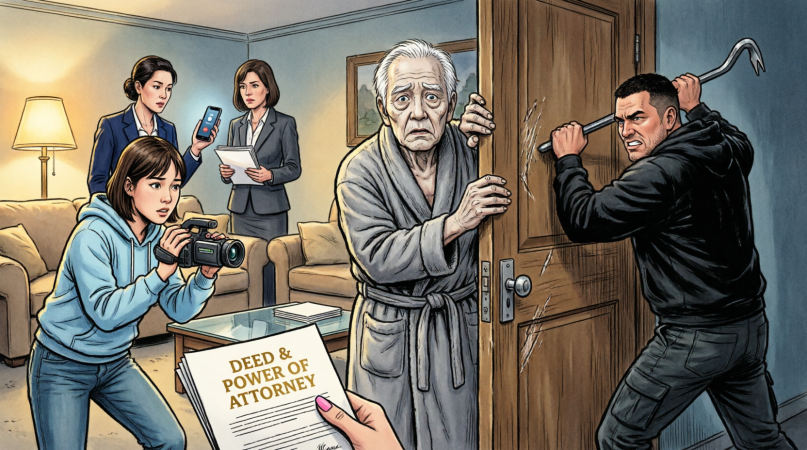
At 1:13 a.m., the sledgehammer struck my front door and made the glass beside it rattle like it wanted to leap out of the frame.
I was halfway down the hallway in my slippers when the second blow bent the lock plate inward.
Outside, Nolan stood beneath the yellow security light with both hands wrapped around the handle.
Vanessa stood beside him holding a tan folder against her chest.
The porch boards were wet with mist.
The sledgehammer head had silver scratches across one side.
Cold air leaked through the damaged frame and carried the smell of metal, dust, and rain.
“Open the door, Dad!” Nolan shouted.
His voice did not sound drunk.
It did not sound confused.
It sounded decided.
“Sign the papers and nobody gets hurt!”
The sentence moved through me like ice water.
Behind me, Lorraine touched my shoulder.
“Do not open it yet,” she whispered.
Mia stood half hidden near the staircase, pale as linen, both hands around the old camcorder.
The red light blinked once.
Then again.
I thought of all the birthdays she had spent at that house.
I thought of my wife teaching her to roll pie crust on the kitchen counter.
I thought of Nolan carrying her on his shoulders at the county fair when she was small enough to believe fathers could not become strangers.
The door shook again.
My phone slipped from my hand and skidded across the hallway floor.
The screen lit up.
Nolan saw it through the side window.
“Don’t call anyone,” he snarled.
Then he said the line that told me this had never been about a sudden temper.
“We already told them you’re confused.”
Not fear.
Not concern.
Preparation.
Lorraine’s face changed when she heard that.
It was not shock.
It was recognition.
She lifted the recorder so the microphone pointed toward the door.
“Now open it,” she said.
I slid back the chain with fingers that did not feel like mine.
The door opened only three inches before Nolan shoved it hard.
Wood cracked against the chain plate.
I stepped back.
Mia stepped forward.
The camcorder rose.
Nolan froze as though the porch light had turned him into something pinned and exposed.
Vanessa saw Mia next.
Color left her face so fast I thought she might faint.
Mia did not scream.
She did not ask why.
She did not call him Dad.
She looked through the lens and said, “Tell him what you did to Grandma.”
The hallway became so quiet I could hear Vanessa’s folder scrape against the buttons of her coat.
Nolan’s mouth opened.
Nothing came out.
Then his grip tightened on the sledgehammer.
I thought seeing Mia alive would stop him.
It only made him more desperate.
He lifted the hammer again, not toward me this time, but toward the side window.
Lorraine moved between us.
“Every word after this becomes evidence,” she said.
Nolan laughed once.
It was a terrible sound because it was almost normal.
“You think a little recorder fixes this?” he asked.
“No,” Lorraine said.
Then Mia reached into her sweatshirt pocket and pulled out the blue flash drive.
Vanessa made the small broken sound that told me she knew exactly what it was.
The tape on the drive had my wife’s handwriting.
Nightstand recording copy.
I had seen that handwriting on grocery lists, birthday cards, prescription notes, and labels for freezer soup.
Seeing it there, wrapped around evidence, nearly put me on the floor.
Lorraine said, “Nolan, before you swing that hammer again, you should know your mother’s voice is on the first file.”
Nolan turned on Vanessa.
For one second, the entire plan split open between them.
“You said she deleted it,” he whispered.
Vanessa looked at Mia.
Mia looked back.
“I did,” Mia said. “From your laptop.”
The sirens arrived at 1:19 a.m.
Lorraine had called before Nolan ever touched the door.
The sheriff’s deputies came through the yard with lights flashing across the windows, blue and red washing over the wallpaper my wife had chosen twenty years earlier.
Nolan dropped the sledgehammer only when Deputy Harris told him to.
Vanessa tried to explain first.
She said I was confused.
She said Lorraine had manipulated me.
She said Mia was unstable and had stolen family property.
Then Lorraine played the first thirty seconds of the porch recording.
Nolan’s own voice filled my hallway.
Sign the papers and nobody gets hurt.
Deputy Harris stopped writing.
The second deputy looked at the broken lock plate.
Nobody asked Vanessa to explain anything for a while.
They separated us in different rooms.
I sat at the kitchen table with a blanket over my shoulders though I was not cold anymore.
Mia sat beside me and held my hand under the table.
Her fingers were freezing.
I wanted to apologize for not seeing sooner.
The words would not come.
She leaned against my shoulder first.
That mercy nearly broke me.
Lorraine gave the deputies copies of the deed, the medical power of attorney, the rejected county filing note, and the audio from the hallway.
Then Mia gave them the flash drive.
The first recording was my wife’s voice.
It was thinner than I remembered and stronger than I expected.
She told Nolan to stop pressuring me.
She told Vanessa she knew about the deed.
She said Lorraine had a copy of the current will and that any attempt to isolate me after her death should be treated as coercion.
Then Vanessa’s voice came through, sharp under the softness.
“You’re making this harder than it needs to be.”
My wife answered, “No. I am making it documented.”
I put my hand over my mouth.
Mia began to cry then, silently, the way children cry when they have been forced to be brave too long.
Nolan said little after that.
The arrogance drained out of him once the room filled with people who could not be bullied by family history.
The deputies took photographs of the damaged door.
They bagged the sledgehammer.
They took the tan folder from Vanessa and separated each page.
The will.
The power of attorney.
The deed.
All neat.
All ready.
All waiting for a frightened old man’s hand.
By dawn, Nolan and Vanessa were gone from my porch.
The house was damaged, but still mine.
That distinction mattered.
The next weeks were not clean or satisfying in the way stories sometimes pretend justice is satisfying.
There were interviews.
Statements.
Calls from people who wanted me to forgive because forgiveness is cheaper for bystanders than accountability.
Nolan’s sister-in-law sent me a message saying families should not let lawyers destroy them.
I typed three different replies and deleted all of them.
Then I blocked the number.
Lorraine filed notices with the county recorder’s office and my bank.
She updated my estate documents with two additional safeguards.
She arranged for copies to be held by her firm and by the court registry.
Mia moved into my guest room for a while.
She slept with the hallway light on for eleven nights.
On the twelfth, she turned it off herself.
That was the first victory I trusted.
The legal process took months.
Nolan pleaded to lesser charges related to attempted coercion, property damage, and elder exploitation.
Vanessa faced charges tied to the fraudulent documents and false reports about my competency.
The court ordered restitution for the door, prohibited contact without approval, and voided every document connected to the attempted transfer.
None of those words fixed what had happened.
But they put a border around it.
They said the truth out loud in a place where paper mattered.
Mia testified once.
She wore a pale blue sweater my wife had bought her the Christmas before she died.
Her voice shook when she described the nightstand recording.
It steadied when she described the porch.
She did not look at Nolan when she said, “He wanted Grandpa to be too scared to say no.”
I watched my son bow his head.
I waited for grief to feel simple.
It never did.
Love does not vanish just because someone betrays you.
It becomes dangerous if you let it drive.
So I let the court drive.
I let Lorraine drive.
I let evidence drive.
After the hearing, Mia and I went home through the same front door Nolan had tried to break.
The frame was repaired by then.
The new lock was stronger.
The side window had been replaced with thicker glass.
But I kept the old bent lock plate in a drawer in the kitchen.
Not because I liked remembering.
Because forgetting had almost cost me everything.
That night, Mia found her grandmother’s blue sweater on the back of the chair.
I had still not moved it.
She touched the sleeve and asked if she could wear it.
I said yes.
She pulled it around her shoulders, and for one unbearable second, my wife seemed to be standing in the kitchen with us, not as a ghost, not as a wound, but as proof that love can leave instructions.
The house felt different after that.
Not healed.
Not empty.
Guarded.
Mia finished her senior year from my kitchen table.
Lorraine came by every few weeks with papers for me to sign and lemon cookies she pretended were for Mia.
I learned to answer unknown numbers without shame and to hang up when kindness arrived carrying pressure.
Sometimes I still hear the hammer in dreams.
Sometimes I wake before dawn and look toward the hallway, expecting the glass to rattle.
But then I hear Mia moving around upstairs, making too much noise with the old plumbing, and I remember the ending Nolan did not plan for.
He thought I was alone.
He thought grief had made me weak.
He thought calling me confused would make everyone stop listening.
He forgot my wife had known him longer than anyone.
He forgot Mia had learned courage from her grandmother.
He forgot evidence can sit quietly in a drawer until the night someone decides to raise a hammer.
People who plan to steal from you rarely begin with a hammer.
They begin with concern.
And sometimes the only way to survive that kind of concern is to leave the door shut until the right witness is standing behind you.
