Ten years ago, an ordinary Saturday turned into the worst day of my life.
I was preparing lunch while my husband played hide-and-seek with our four-year-old daughter, Margot, in the backyard. Their laughter drifted through the house, and I smiled as I listened.
Then, suddenly, everything went silent.
A few minutes later, my husband came rushing into the kitchen, his face filled with panic.
“Margot’s gone.”
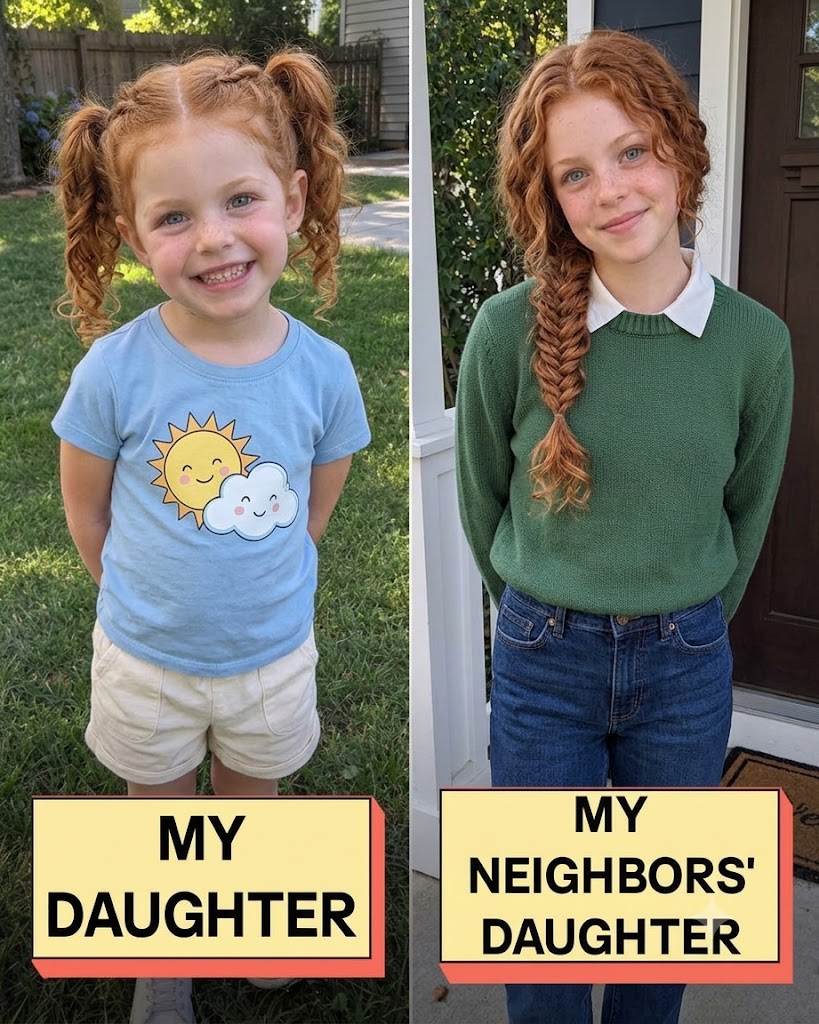
For a moment, I didn’t understand what he meant. They had been playing hide-and-seek, and Margot was supposed to hide while he counted. But when he went to find her, she was nowhere. He searched the entire backyard and then the house before fear completely took over.
Within hours, police officers, neighbors, and volunteers were combing the area. The search went on for months, but there wasn’t a single trace of our little girl.
Eventually, the people around us began to lose hope.
But I couldn’t.
Our home, once filled with Margot’s laughter, became almost impossible to live in. Every room reminded me of her, yet the only thing I heard was silence. Eventually, we moved away, hoping that leaving would give us a chance to keep living.
I knew everyone expected me to move on, but deep inside, I never stopped believing that somehow, someday, we might find our daughter.
Years passed.
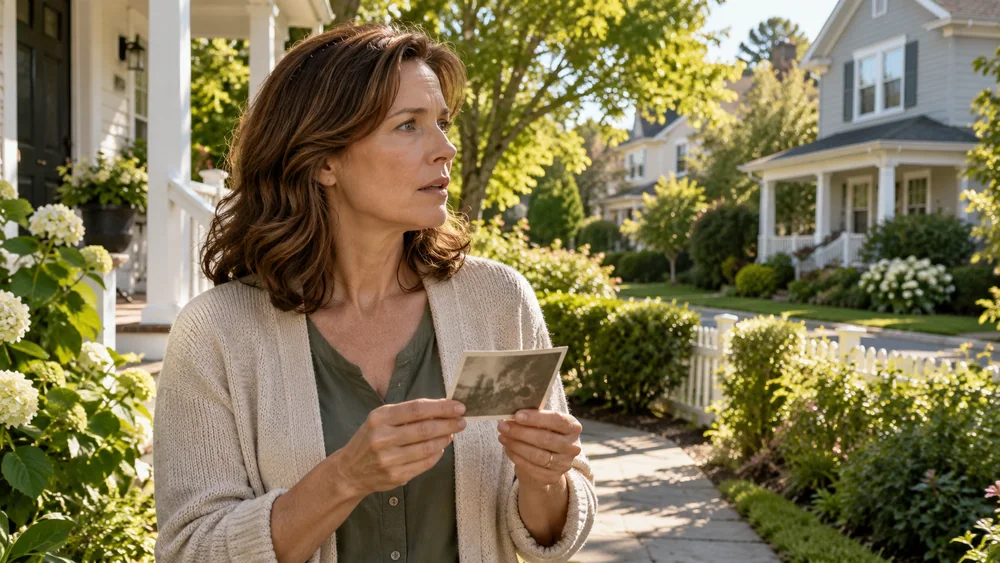
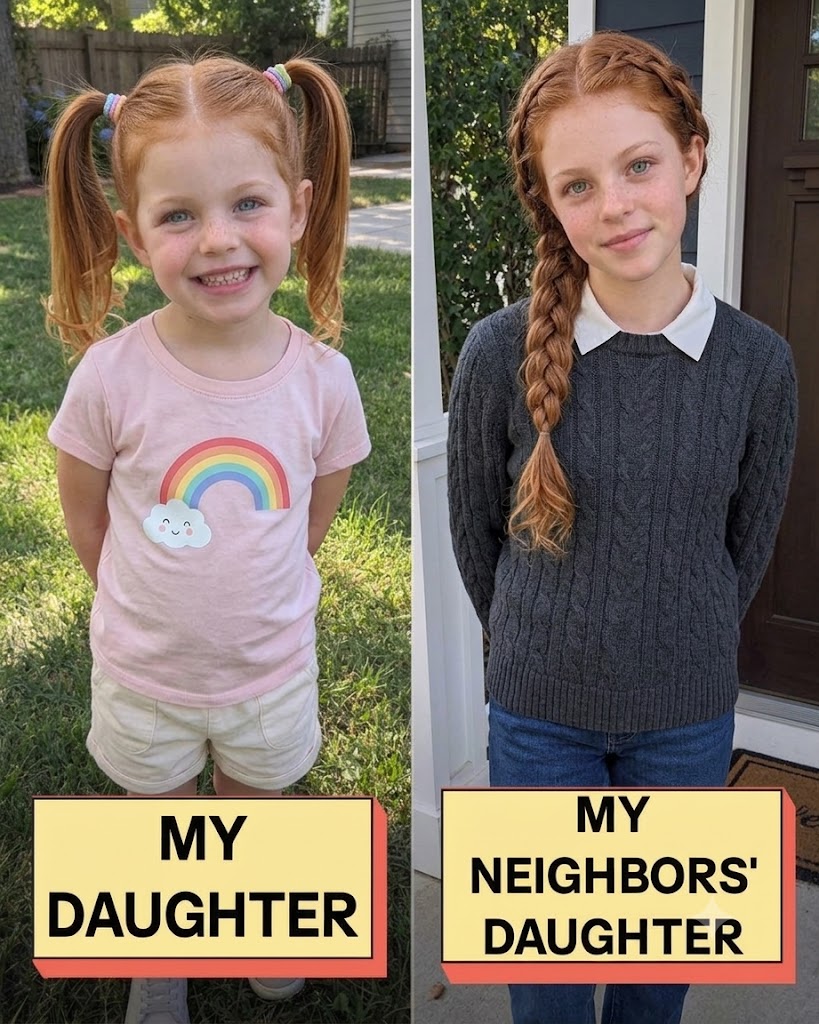
Then, last month, a new family moved into the house next door. A few days later, the parents came over to introduce themselves. We were standing on the porch chatting when they called their fourteen-year-old daughter over.
The moment she walked toward me, something inside me changed.
Then she looked directly into my eyes.
My heart stopped.
She had Margot’s eyes.
The exact same shape. The same expression.
“Margot?” I whispered, barely able to get the word out.
The instant her parents saw my reaction, her father grabbed the girl by the arm and pulled her behind him.
Her mother stared at me for a long moment.
Then she quietly said, “We knew this day might come.”
“We knew this day might come.”
I stared at Joan, unable to make sense of her words.
“How could you possibly know?” I asked.
Joan took a shaky breath.
“Three weeks ago, I found an old article online about a little girl who disappeared ten years ago. The photograph was of Margot.”
My entire body went cold.
“You saw my daughter?”
“I saw the picture,” Joan said. “And then I looked at Mia. The age matched. The timing matched. And there were things about her that made me wonder.”
Thomas stepped closer to his daughter.
“We thought it could be a coincidence,” he said. “We weren’t going to tell Mia she might be a missing child based on a photograph.”
But now they had moved into the house next door, and the coincidence was standing right in front of me.
Mia looked from her parents to me, clearly confused.
“And my name is Mia,” she said quietly. “Not Margot.”
I swallowed hard.
“You’re right. I’m sorry.”
For ten years, I had imagined this moment differently. I had imagined my little girl running into my arms, calling me Mom.
Instead, the girl standing in front of me was fourteen years old. She had her own memories, her own life, and a family who had raised her.
Still, there was one thing we needed to know.
Whether Mia wanted to find out who she really was.
I asked her directly.
“Would you be willing to take a DNA test?”
She studied me for a long moment.
“If I am Margot, what happens?”
The answer I wanted to give was simple: You come home.
But when I looked around her living room, I saw photographs of birthdays, school events, family vacations. I saw a life that existed without me.
So I told her the truth.
“We figure it out. And you get a say in everything.”
Mia finally agreed.
While we waited for the test, Joan showed us the records she had kept from Mia’s childhood.
Then I saw something that made my hands go numb.
There was an old report about a little girl who had been found asleep near the end of a bus route on the very afternoon Margot disappeared.
The girl had known her first name.
She called her parents “Mommy” and “Daddy.”
But she couldn’t give anyone an address. All she could remember was a yellow house, a bus stop, and a tree with a swing.
I looked at Greg.
The bus stop across from our house.
The one we’d used with Margot.
Suddenly, the impossible didn’t seem impossible anymore.
Somewhere along the way, a little girl who had been found alone had entered the system under incomplete or incorrect information. She eventually went into foster care.
And years later, Joan and Thomas became her legal parents.
No one had deliberately stolen Margot.
No one had hidden her from us.
A chain of mistakes had simply kept two families from finding each other for ten years.
Then the DNA results arrived.
Mia was our biological daughter.
Margot was alive.
I thought finding her would feel like winning her back.
It didn’t.
Because when the tears came, Mia reached for Joan first.
Joan had been the mother who held her through nightmares, taught her to ride a bike, celebrated her birthdays, and stayed beside her when she was sick.
Then Mia looked at me and slowly held out her other hand.
I took it.
I didn’t pull her toward me.
I didn’t tell her she was coming home.
I simply held her hand.
Because finding Margot didn’t erase Mia.
And becoming her biological mother didn’t erase the woman who had raised her.
A week later, one of my relatives pulled me aside.
“When does she come home?”
I looked across the room at Mia.
“Don’t talk about her like she’s something that was borrowed.”
“But she’s yours.”
“She is,” I said. “And she’s theirs, too.”
That night, Mia found me sitting alone on the porch.
“Did you mean what you said?”
“Every word.”
She sat beside me.
Then she asked the question I’d been afraid to hear.
“Do you want me to live with you?”
Every selfish part of me screamed yes.
“I want every day I lost,” I admitted. “But those days aren’t mine to give back.”
She looked confused.
“You already have a life. You have parents, friends, memories. I don’t want finding me to become another way you lose everything.”
Her eyes filled with tears.
“So I don’t have to choose?”
“No.”
“Even if I still call Joan Mom?”
“Especially then.”
For the first time, I realized something I’d spent ten years refusing to accept.
I wasn’t getting my four-year-old daughter back.
That little girl was gone, not because she had died, but because she had grown up.
Months later, Mia sat beside me on the living room floor as I opened the old memory box I’d kept for ten years.
Inside were a tiny shoe, a plastic bracelet, an old picture book, and a little dress she had once hated wearing.
She picked up the dress.
“You put me in this?”
I laughed through my tears.
“You hated it.”
She looked at me.
Then she smiled.
“Tell me.”
So I told her everything.
How she used to hide behind her father whenever someone took out a camera. How she kicked her shoes off under the table. How she spilled juice on that dress twenty minutes after I put it on her.
Mia laughed.
Then she asked another question.
And another.
For ten years, I’d dreamed about finding Margot exactly as I’d lost her — four years old, running through the backyard and calling me Mom.
Life gave me something different.
It gave me a fourteen-year-old girl named Mia, who had another family, another set of memories, and a life I hadn’t been part of.
And once I stopped trying to drag her back into the past, I finally understood how to move forward.
I wasn’t waiting for Margot to come home anymore.
I was finally getting to know my daughter.
Mia handed the little dress back to me.
“Keep going,” she said.
“With what?”
“The stories.”
So I did.
And for the first time in ten years, the silence in my house didn’t feel empty anymore.