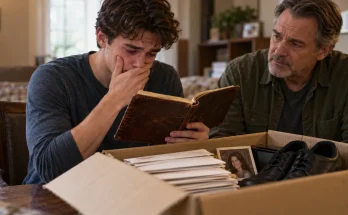

After my wife died, I was certain that part of my life had ended with her.
Then Claire came along.
She never tried to erase Sarah. She never asked my daughter to call her Mom. She simply stepped into our broken little world with patience, warmth, and a kind of gentleness I hadn’t realized we needed.
Eventually, I married her.
For the first time in years, our house felt alive again.
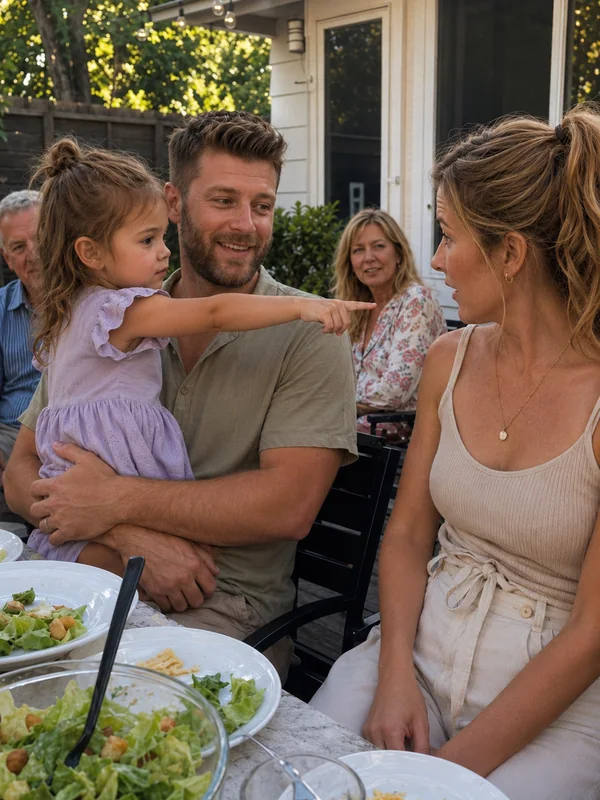
Then, during our first big family dinner after the wedding, my four-year-old daughter suddenly stood up, pointed directly at Claire, and shouted one word that froze everyone at the table.
“MONSTER.”
What she said afterward changed the way I understood grief, love, and my own daughter forever.
It began four years earlier, at almost three in the morning.
Rain tapped softly against the nursery window while I paced across the carpet with a screaming newborn against my chest.
I hadn’t slept properly in nearly two days.
My shirt was stained with formula. My eyes burned. My arms felt numb from holding Ari.
But exhaustion wasn’t the worst part.
Grief was.
Ari cried harder, her tiny face red as she pressed against my shoulder.
“I know, baby,” I whispered, bouncing her gently. “I miss her too.”
The words escaped before I could stop them.
I froze.
How could my daughter miss someone she had never even met?
Sarah had died only hours after giving birth.
She never got to hold Ari.
Never kissed her forehead.
Never heard her cry.
Never brought her home from the hospital.
The doctors had spoken to me in careful voices that day, as if speaking softly could somehow make the words less devastating.
There had been complications.
Then there had been an emergency.
Then suddenly there was no Sarah.
Only me.
And a newborn baby who needed everything from a man who barely remembered how to breathe.
That night in the nursery, my phone was sitting on the rocking chair.
There was one recording on it I had almost been afraid to listen to.
Sarah had made it during the final month of her pregnancy.
She had been lying on the couch with one hand over her stomach while I complained that our daughter was probably going to inherit my stubbornness.
Sarah laughed.
“If our little girl inherits your stubbornness,” she said, “she’ll probably need this someday.”
Then she recorded herself singing a lullaby.
It wasn’t polished.
She forgot some lyrics halfway through and hummed the parts she couldn’t remember. At one point she started laughing because Ari kicked so hard that Sarah lost her place.
I picked up the phone and pressed play.
Sarah’s voice filled the dark nursery.
Within seconds, Ari stopped crying.
Her little body relaxed against me.
I stared down at her.
“That’s your mommy,” I whispered.
Then I kissed the top of her head and stood there crying silently until the recording ended.
People asked me afterward when life started feeling normal again.
It never did.
The first two years weren’t really living.
They were survival.
I changed diapers while trying not to cry.
I fell asleep on the nursery floor because Ari would wake whenever I tried to move her.
I went back to work long before I was emotionally ready because grief didn’t pay hospital bills, buy diapers, or keep food in the refrigerator.
Some mornings, I was so exhausted I would pour cereal into a bowl, put the milk in the cupboard, and place the cereal box in the refrigerator.
My mother eventually moved in temporarily.
Without her, I honestly don’t know how I would have managed.
She cooked.
Did laundry.
Held Ari while I slept.
She also made sure Sarah remained part of the house.
Photographs stayed on the walls.
Sarah’s favorite mug stayed in the kitchen cabinet.
Her old scarf remained hanging beside the front door for months because neither Mom nor I could bring ourselves to move it.
When Ari was almost two, she began noticing the photographs.
One afternoon, she pointed at a picture of Sarah laughing on a beach.
“Who dat?”
I sat beside her.
“That’s your mommy.”
Ari studied the picture carefully.
“She funny?”
I smiled.
“The funniest person I ever knew.”
Ari thought about that.
“How Mama talk, Daddy?”
My smile always became harder to hold when she asked questions like that.
“Beautiful.”
“Can I hear Mama?”
Sometimes, I played the lullaby.
Sometimes, I couldn’t.
Whenever Sarah’s voice filled the room, it felt as though I lost her all over again.
I told myself Ari was too young to understand everything.
But that wasn’t the real reason.
The truth was that I wasn’t ready.
By the time Ari turned two, she had developed a personality that fascinated me.
She wasn’t exactly shy.
She simply watched people before trusting them.
At playgrounds, she would stand beside me for several minutes, studying the other children before deciding whether to join.
At birthday parties, she would hide behind my leg until she understood the room.
Then suddenly she would smile and become the happiest child there.
For her second birthday, I decided I wanted to buy her something special.
That decision led me into a toy store where I immediately realized I had absolutely no idea what two-year-old girls considered special.
I stood in the middle of an aisle surrounded by dolls, puzzles, stuffed animals, glittery boxes, and toys that made noises I didn’t understand.
A cheerful voice came from behind me.
“Shopping for someone important?”
I turned.
That was the first time I saw Claire.
She stood behind the counter wearing a blue apron decorated with embroidered stars.
“My daughter,” I said.
“How old?”
“Two.”
Claire looked past me.
Ari had both arms wrapped around my leg, half hiding behind me while watching Claire cautiously.
Most adults immediately crouched in front of Ari and started asking questions.
“What’s your name?”
“How old are you?”
“Do you like dolls?”
Claire didn’t.
Instead, she ducked behind the counter.
A second later, a floppy stuffed rabbit slowly appeared above the edge.
It looked left.
Then right.
Then whispered loudly enough for Ari to hear.
“I don’t think anybody can see me.”
Ari’s grip on my leg loosened.
The rabbit suddenly spun around and fell dramatically onto the floor.
Ari giggled.
The rabbit popped up again.
“I meant to do that.”
Another giggle.
Two minutes later, Ari was standing beside the counter making the rabbit hop between her hands.
Claire looked at me and smiled.
“There she is.”
That sentence stayed with me.
Because somehow, within minutes, Claire had noticed something about my daughter that many adults never understood.
Ari didn’t need attention.
She needed patience.
Before we left, Claire slipped a small rainbow sticker into Ari’s shopping bag.
“For the birthday girl.”
Ari hugged that bag the entire drive home.
A week later, she informed me that the rabbit probably missed her.
So we went back.
Claire saw us walk through the door and laughed.
“I was wondering if the rabbit would ever see his friend again.”
I don’t remember exactly how we went from toy-store conversations to coffee.
But we did.
Coffee became dinner.
Dinner became weekend walks.
Weekend walks became afternoons when none of us wanted to go home.
On our third real date, I told Claire about Sarah.
Not just that she had died.
Everything.

I told her how quickly everything had happened.
I told her how guilty I felt whenever I laughed.
How sometimes I woke up after having a good dream and felt ashamed because Sarah hadn’t been in it.
How part of me believed falling in love again would somehow mean betraying the woman I had promised forever to.
Claire listened without interrupting.
When I finally stopped talking, she reached across the table.
“You don’t have to stop loving Sarah.”
I stared at her.
“I don’t?”
She gave me a sad, gentle smile.
“Love doesn’t work that way, Paxton.”
Nobody had ever said that to me.
People had told me to move on.
They told me Sarah would want me to be happy.
They told me I was still young.
But moving on always sounded like leaving Sarah behind.
Claire never asked me to do that.
She simply made room for Sarah.
That was when I realized I was falling in love again.
It terrified me.
It also felt like breathing after years of holding my breath.
Claire entered Ari’s life slowly.
She colored beside her without taking over the picture.
She read stories only when Ari placed a book in her lap.
She learned that dinosaurs required completely different voices from teddy bears.
One rainy afternoon, I walked into the living room and found them beneath a blanket fort.
Claire was pretending to be a dragon.
Ari was ordering her to guard a pile of plastic fruit.
They were laughing so hard neither noticed me standing there.
I watched them for several seconds.
Something inside me cracked open.
Over the following months, Claire became part of our family one careful step at a time.
She never asked Ari to call her Mom.
She never moved Sarah’s photographs.
When Claire eventually wanted to hang a picture of the three of us in the hallway, she stopped before touching the wall.
“Would you like Sarah’s pictures to stay exactly where they are?”
I looked at her.
“You’d be okay with that?”
“Of course.”
She seemed genuinely confused that I would even ask.
“They’re part of your family.”
I loved her more in that moment.
More than two years after we met, Claire and I got married.
It was small.
A garden.
White flowers.
Close family.
Sunshine.
Ari served as our flower girl, although she spent most of the ceremony throwing petals in the wrong direction.
Everyone laughed.
Even the photographer.
For the first time since Sarah’s death, happiness didn’t feel like something I had stolen from my old life.
Maybe happiness wasn’t betrayal.
Maybe it was simply something the future had been saving for us.
After the wedding, Claire fit naturally into our everyday routines.
She packed Ari’s lunches.
She danced while making pancakes.
She convinced my incredibly picky daughter that broccoli was actually “tiny superhero trees.”
The house changed.
There was music in the kitchen.
Shoes left in the hallway.
Half-finished drawings on the refrigerator.
Laughter where silence had lived for years.
My mother noticed it too.
During one visit, she stood in the kitchen listening to Claire and Ari laugh.
“So this is what laughter sounds like again,” she whispered.
I thought everything was finally becoming whole.
But there were moments I couldn’t explain.
One morning, Claire braided Ari’s hair before preschool.
Ari loved it.
She ran through the house admiring herself in every reflective surface she could find.
Twenty minutes later, I found her standing silently in front of Sarah’s photograph.
She didn’t say anything.
She simply stared.
Another evening, Claire tucked her into bed after reading three stories.
Five minutes later, Ari appeared in my bedroom carrying her blanket.
“Daddy?”
“What is it, sweetheart?”
“Can Mommy sing?”
I knew exactly which mommy she meant.
I took out my phone and played Sarah’s lullaby.
Ari hugged her stuffed rabbit.
Before the song ended, she was asleep.
It happened again the following week.
And again.
Whenever Claire and Ari had an especially happy day together, Ari seemed to search for Sarah afterward.
I assumed it was normal.
Claire wasn’t so sure.
One night she admitted, “I feel like she pulls away whenever we get close, Paxton.”
“She’s adjusting.”
“I hope so.”
Neither of us understood what was actually happening.
Then came last night.
I invited my parents and younger sister over for dinner.
It wasn’t exactly a celebration.
More of a thank-you.
My family had carried Ari and me through the worst years of our lives.
Now I wanted them to sit in our home and see that we were okay.
That maybe we were finally building something hopeful again.
Claire spent the afternoon cooking.
Roasted chicken filled the house with its smell.
Fresh bread cooled on the counter.
An apple pie waited beneath a clean kitchen towel.
Ari, now four, insisted on helping set the table.
She placed two forks beside one plate and no fork beside another.
Claire quietly corrected everything without embarrassing her.
When the doorbell rang, Ari raced to answer it.
Mom immediately scooped her into a hug.
Dad arrived carrying flowers.
My sister stepped into the house, inhaled dramatically, and announced, “If dinner tastes half as good as this house smells, I’m moving in.”
Dinner was chaotic in the best possible way.
My sister convinced Ari that peas were tiny planets.
Soon they were launching them across their plates while making exaggerated “whoosh” sounds.
Claire laughed so hard tears appeared in her eyes.
I remember sitting there watching her with my family and thinking how naturally she belonged.
Then dessert came.
Claire served warm apple pie.
Mom looked around the table.
Her eyes became wet.
“I haven’t seen this house this happy in years.”
Dad squeezed her hand.
Mom turned toward Claire.
“I’ve wanted to tell you something all evening.”
Claire smiled.
“What is it?”
Mom dabbed her eyes with a napkin.
“I know nobody could ever replace Sarah.”
Claire nodded.
“And nobody should.”
Mom reached across the table and covered Claire’s hand.
“But I’m so grateful someone as kind as you is taking care of Paxton and Ari.”
She glanced at me.
“I think Sarah would finally be at peace knowing they aren’t alone anymore.”
For a few seconds, the room became beautifully quiet.
Then a chair scraped violently across the floor.
Ari was standing.
Her small hand rose.
Her finger pointed directly at Claire.
“She’s a MONSTER.”
Every sound vanished.
My sister froze with her fork halfway to her mouth.
Dad stared at Ari.
Mom blinked in shock.
Claire stopped moving, one hand still wrapped around her coffee cup.
I tried to laugh.
It came out hollow.
“Sweetheart…”
Ari didn’t lower her finger.
“Why would you call Claire a monster?” I asked.
Her wide eyes filled with fear.
“Because…”
Her voice dropped to a whisper.
“…when I love Claire… Mommy starts fading.”
It felt like ice water had been poured through my chest.
Nobody spoke.
Ari twisted the edge of her dress between her fingers.
“When Claire brushes my hair now…” she said, glancing toward Sarah’s photograph on the mantel, “…I can’t remember Mommy doing it.”
My chest tightened.
Of course she couldn’t.
Sarah had never brushed her hair.
Ari continued.
“When Claire hugs me…” She pressed both hands against her chest. “…I forget what Mommy’s hugs were supposed to feel like.”
Mom covered her mouth.
Tears rolled down Ari’s cheeks.
“When people say she’s our new mommy now…”
Her lower lip trembled.
“…my real Mommy goes away forever.”
Claire’s face crumpled.
Ari began sobbing.
“In stories, monsters make people disappear.”
Everything suddenly made sense.
The photographs.
The lullaby.
The way she pulled away from Claire after their happiest moments.
Ari hadn’t been rejecting Claire.
She had been fighting desperately to hold on to a mother she had never been given the chance to know.
And then an even harder realization hit me.
I had helped create that fear.

Every time Ari asked about Sarah and I gave a short answer because talking hurt too much.
Every time I stopped the lullaby early.
Every memory I avoided because reopening it felt unbearable.
I thought I was protecting my daughter from grief.
Instead, I had accidentally taught her that Sarah was something fragile.
Something that could vanish if nobody talked about her.
Claire slowly stood.
No one said anything as she walked out of the dining room.
For one horrible moment, I wondered whether my daughter had broken her heart.
Then Claire returned.
She was carrying Sarah’s framed photograph.
She brought it to the table and placed it carefully on the empty chair beside Ari.
Then she moved her own chair slightly farther away.
“Your mommy gets a seat too, sweetheart.”
Ari stared at her.
Claire’s eyes were full of tears.
“I don’t want anyone to disappear.”
She touched the edge of the frame gently.
“I’ve never wanted Sarah’s place.”
Ari sniffled.
Claire crouched beside her.
“Will you tell me something about your mommy?”
Ari lowered her eyes.
“I don’t know enough.”
Those four words broke something inside me.
I leaned forward.
“I do.”
Everyone looked at me.
I took a breath.
“Your mommy couldn’t bake blueberry muffins.”
Ari looked shocked.
“But Grandma says she could.”
I laughed softly.
“Grandma is remembering the second batch.”
Mom smiled through her tears.
“The first batch was terrible.”
“She forgot the sugar,” I said. “Then she insisted nobody would notice.”
Dad chuckled.
“Your father ate three anyway.”
I shrugged.
“They tasted like warm bread.”
Ari giggled.
And suddenly, Sarah wasn’t a tragedy we had to whisper about.
She became a person again.
I told Ari how Sarah sang completely off-key while cleaning the kitchen.
Mom told her how Sarah cried every single time an animal rescue commercial came on television.
Dad remembered the time Sarah tried to assemble a bookshelf without instructions and somehow ended up with three extra pieces.
Then I told Ari how Sarah used to talk to her every night while she was pregnant.
“She believed babies recognized voices before they were born,” I explained.
Ari stared at Sarah’s photograph.
“She talked to me?”
“Every day.”
“What did she say?”
“That she loved you.”
Ari’s eyes filled again.
This time, she smiled through the tears.
For the first time since Sarah died, we didn’t avoid saying her name.
We invited her back into the room.
Claire never interrupted.
She listened.
She laughed when we laughed.
She cried when we cried.
Eventually, Ari climbed into her lap.
Claire wrapped one arm gently around her.
“So…” Ari whispered. “You still love me?”
“Very much,” Claire said.
“Even if Mommy stays?”
Claire kissed the top of her head.
“I hope she always stays.”
Ari frowned.
“But where do you go?”
Claire smiled.
“I don’t need your mommy’s place.”
She tapped Ari lightly on the nose.
“I’d like my own place.”
The next morning, I walked into the kitchen and found Claire holding an old metal recipe tin.
“I found this in the back of the cabinet,” she said.
Inside were Sarah’s handwritten recipes.
The card sitting on top was for blueberry muffins.
Claire looked at me.
“What do you think?”
I understood immediately.
She wasn’t trying to replace Sarah.
She was inviting her back into our home.
So the three of us baked muffins.
Flour covered the counter.
Ari cracked eggs with far more enthusiasm than accuracy.
Claire burst out laughing when batter splashed onto her sleeve.
Half the muffins rose crooked.
One burned around the edges.
Ari examined the tray proudly.
“They’re perfect.”
I reached for my phone.
For the first time in years, I played Sarah’s lullaby without walking into another room.
Her voice floated through the kitchen.
The pain was still there.
I don’t think it will ever disappear completely.
But that morning, the recording didn’t feel like another goodbye.
It felt like a gift.
Ari placed three napkins on the breakfast table.
Then she stopped.
She looked toward the windowsill.
Without saying anything, she climbed down from her chair, picked up Sarah’s photograph, and placed it beside us.
Then she added a fourth napkin beneath the frame.
Claire carried over the muffins.
She carefully chose the least-burned one and placed it beside Sarah’s picture.
Ari looked at it.
Then at Claire.
Finally, she slipped her little hand into Claire’s.
Not because she had forgotten her mother.
Because she finally understood that loving Claire would never require her to forget Sarah.
I looked around that messy kitchen.
Blueberry muffins.
Sarah’s imperfect lullaby.
Claire’s gentle smile.
My daughter laughing.
Four places at the table.
One family.
No one had been replaced.
Love had simply grown large enough to hold all of us.
Note: This story is a work of fiction inspired by real events. Names, characters, and details have been altered. Any resemblance is coincidental. The author and publisher disclaim accuracy, liability, and responsibility for interpretations or reliance.