tt_Part 2: My Parents Cast Me Out at Nineteen, but Ten Years Later My Son Returned With the Secret That Exposed Their Greatest
My father stared at the phone in my hand as if it were a weapon.
“What restriction?” he demanded. “What happened ten years ago?”
Attorney Michael Lawson was still on the line.
I turned toward the window, struggling to breathe past the fear that had lived inside me since I was nineteen.
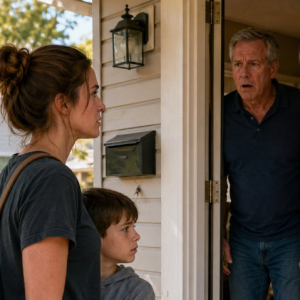
“Mr. Lawson,” I said, “can you come here?”
There was a pause.
“I’m already nearby,” he replied. “I expected you might return to Ohio once the restriction expired. I can be there in twenty minutes.”
When the call ended, my mother gripped the back of a dining chair.
“Emma, please,” she whispered. “Tell us what this is about.”
I looked at Leo.
He was standing beside the fireplace, studying a framed photograph of me from high school. In the picture, I was wearing my graduation gown and smiling beside my father. Back then, I had believed my parents would protect me from anything.
I had been wrong.
“Leo,” I said gently, “would you like to look at the backyard? There used to be a swing near the maple tree.”
He understood immediately that the adults needed to talk.
“I’ll be okay,” he said.
My mother opened the back door for him, but before stepping outside, Leo turned to me.
“You promised no more secrets after today.”
My chest tightened.
“I promise.”
When the door closed, my father folded his arms.
“Start talking.”
“The father wasn’t married,” I said. “He wasn’t twice my age. And I wasn’t ashamed of him.”
“Then why wouldn’t you give us his name?”
“Because I was ordered not to.”
My father laughed bitterly.
“Ordered by whom?”
“By a federal investigator.”
The anger disappeared from his face.
My mother sank slowly into a chair.
I continued before I lost my courage.
“Leo’s father was Daniel Mercer.”
My father blinked.
The name struck him immediately.
Daniel had grown up three streets away from us. He had been the quiet, hardworking son of a mechanic. He had played baseball with my brother before my brother moved overseas. My parents had known him since he was twelve.
My mother covered her mouth.
“Daniel?” she whispered. “The young man who died in that car accident?”
“It wasn’t an accident.”
The clock above the fireplace ticked loudly.
My father’s arms dropped to his sides.
I had carried those words for ten years. Saying them aloud should have brought relief.
Instead, it felt like reopening a wound that had never healed.
“Daniel had taken a temporary accounting job at Vantage Medical Systems,” I explained. “He discovered the company was billing the government for equipment that had never been manufactured. Millions of dollars were being moved through false charities and private accounts.”
My father shook his head slowly.
“What does that have to do with you?”
“Daniel copied the records. He planned to take them to the authorities. But before he could, someone inside the company found out.”
My mother’s face had gone pale.
“The night before I told you I was pregnant, Daniel came to see me. He was terrified. He gave me a flash drive and told me not to open it unless something happened to him.”
I could still remember that night.
Daniel standing beneath the streetlight outside my parents’ house.
Rain dripping from his hair.
His hands trembling as he pressed the drive into my palm.
If anyone asks, you haven’t seen me.
Those had been his final words to me.
“Two days later, his car went off a bridge,” I said. “The police called it an accident. But that same evening, two men followed me home from work.”
My father gripped the arm of his recliner.
“You never told us.”
“I tried.”
“No, you told us you were pregnant and refused to name the father.”
“Because an investigator told me Daniel’s death was connected to the evidence. He said anyone who knew about our relationship could become a target.”
My voice began to shake.
“I had already told Daniel I was pregnant. He had written it in a private journal that the investigators recovered from his apartment. They were afraid the people who killed him might learn about the baby.”
My mother started crying.
“So they told you to disappear?”
“They gave me a choice. Enter a confidential witness-protection arrangement until the investigation ended, or stay here and risk leading those people to everyone I loved.”
My father turned away.
I could see the muscles tightening across his jaw.
“The case was supposed to last a few months,” I continued. “But Vantage Medical had powerful lawyers, hidden accounts, and officials protecting them. The investigation kept expanding. I wasn’t allowed to reveal Daniel’s name, the evidence, or my location.”
“You could have told us you were in danger,” my father said.
“I tried to tell you there were circumstances I couldn’t explain. You gave me less than an hour to leave.”
The words struck him harder than shouting would have.
My mother lowered her face into her hands.
“I should have stopped him.”
“Yes,” I said.
She looked up, shocked by the bluntness of my answer.
For years I had imagined this reunion. In some versions, I forgave them instantly. In others, I screamed until my voice disappeared.
But standing there, I understood that forgiveness without truth was only another kind of silence.
“You stood behind that door and watched your pregnant daughter walk away,” I said. “You cried, but you didn’t open it.”
“I was afraid of your father.”
“And I was afraid of being murdered.”
My father flinched.
Before either of them could respond, a dark sedan stopped outside.
A tall man in a gray suit walked toward the house carrying a locked leather case.
Michael Lawson looked older than I remembered, but his calm expression had not changed. Ten years earlier, he had been the junior attorney assigned to explain the rules of my protected relocation. Now silver touched his temples.
My father opened the door.
“Mr. and Mrs. Carter?”
“Yes.”
“I believe your daughter has told you part of the truth.”
He placed the case on the dining table and entered a code.
Inside were several folders, a sealed envelope, and a small wooden box.
“The federal prosecution concluded last month,” he explained. “The final defendant was convicted, and all related confidentiality orders expired this morning.”
He handed my father the first folder.
It contained newspaper reports, court documents, photographs and financial records.
Vantage Medical Systems had stolen more than eighty million dollars through fraudulent government contracts. Three executives and a former state official had been convicted. Two men had also been found guilty of arranging Daniel’s death and making it appear accidental.
My mother stared at Daniel’s photograph printed on the first page.
“Oh, that poor boy.”
Michael turned toward me.
“Daniel Mercer’s evidence initiated the entire investigation. Emma preserved it and delivered it to authorities despite credible threats against her life.”
My father looked at me.
“You had the evidence?”
“I hid the flash drive inside the lining of my duffel bag.”
The same duffel bag my father had thrown onto the porch.
Michael continued.
“The men following Emma believed the evidence was still in Ohio. Her sudden departure likely convinced them she had been frightened into running away without it. That assumption protected this household.”
My father’s knees seemed to weaken.
He sat down.
“When she said we would all regret it…”
“She knew that terminating the pregnancy would not erase the danger,” Michael said. “The people responsible already knew Daniel had been close to someone. More importantly, Daniel had left instructions concerning his unborn child.”
He removed the sealed envelope.
The paper had yellowed slightly with age.
My name was written across the front in Daniel’s handwriting.
I had never seen it before.
“What is that?” I asked.
“A letter recovered from a safe-deposit box after Daniel’s death. It remained sealed under court order because it referenced protected evidence and named several suspects.”
My fingers trembled as I opened it.
Emma,
If you are reading this, then I failed to come back and explain everything myself.
I am sorry.
I wanted to ask you to marry me after I finished cooperating with the investigators. I even bought the ring, although I knew you would laugh because I spent too much on it.
I need you to know that I was never afraid of becoming a father. I was afraid I would not live long enough to be one.
Keep our child only if that is what you truly want. Do not let guilt make the decision for you. But if our baby is born, please tell them that their father tried to do one brave thing when it mattered.
You once told me that family means having someone who stays when life becomes frightening.
I hope your family stays.
And if they do not, I hope one day they understand what they lost.
I love you.
Daniel
By the time I reached the final line, I could no longer see through my tears.
My mother sobbed openly.
My father sat motionless, staring at the floor.
Michael opened the wooden box.
Inside was a simple diamond ring.
For ten years, I had believed Daniel died frightened and alone. I had never known he planned a future with me. I had never known he had chosen a ring.
Leo came in through the back door.
He stopped when he saw everyone crying.
“Mom?”
I wiped my cheeks.
“Come here.”
He walked toward me, and I wrapped both arms around him.
“This man is Mr. Lawson,” I explained. “He knew your father.”
Leo’s serious eyes moved toward the letter.
“My dad wrote that?”
“Yes.”
“Can I read it?”
I handed it to him.
Leo read slowly. His lips moved over several of the sentences. When he finished, he held the paper carefully against his chest.
“He was brave,” he said.
“He was,” Michael replied. “And so was your mother.”
My father suddenly stood.
He crossed the room and stopped in front of Leo.
For a moment, I thought he would try to hug him.
Instead, he lowered himself onto one knee.
The proud man who had once ordered me from his house now looked smaller than I had ever seen him.
“Leo,” he said, his voice breaking, “I’m your grandfather. And before you decide whether you want to know me, there is something you deserve to hear.”
Leo waited.
“I failed your mother when she needed me. I thought being a father meant controlling every decision. I cared more about fear, shame and what other people might think than I cared about listening to my own daughter.”
My mother came to stand beside him.
“And I failed her because I stayed silent.”
My father looked at me.
“I told myself for years that you had abandoned us. It was easier than admitting I had driven you away.”
I had waited a decade to hear those words.
They did not erase the night I slept in a bus station.
They did not erase working until my feet bled, raising a feverish baby alone, or sitting in college classrooms after sleeping only two hours.
But they mattered.
Leo looked from them to me.
“Are we staying for dinner?”
Everyone seemed surprised.
“That depends on your mother,” my father said.
Leo squeezed my hand.
“I think people should get one chance to prove they’re sorry.”
My son had inherited Daniel’s kindness.
But he had inherited my caution too.
“One chance,” I said. “Not permission to pretend the past never happened.”
My mother nodded quickly.
“We won’t pretend.”
That evening, we ate at the same dining table where my parents had once discussed my future as though it belonged to them.
My mother burned the rolls because she kept crying.
My father listened as Leo described school, baseball and his dream of becoming an engineer. He did not interrupt once.
Before we left the following morning, my father brought the old duffel bag down from the attic.
“I kept it,” he said. “I don’t know why.”
The zipper was broken. One strap had nearly torn away.
I ran my fingers over the faded fabric.
“That bag carried everything I owned.”
“I know.”
“No,” I said. “It carried everything you let me keep.”
He lowered his eyes.
Then Leo touched the bag.
“It also carried the evidence, right?”
“Yes.”
“Then maybe it didn’t carry what Grandpa let you keep. Maybe it carried what he couldn’t take from you.”
We all looked at him.
“My choices,” I said quietly.
“And your courage,” Leo added.
My father began to cry.
Not the restrained tears of a man embarrassed by emotion, but the broken sobs of someone finally understanding the full cost of his actions.
We did not become a perfect family that weekend.
Trust did not return simply because the truth had.
My parents started calling every Sunday. Sometimes the conversations were awkward. Sometimes I ended them early. My father entered counseling. My mother apologized more than once without asking me to comfort her.
They came to Leo’s baseball games.
They learned not to make promises they could not keep.
A year later, on the anniversary of Daniel’s death, we stood together beside his grave.
Leo placed a baseball on the grass.
“I know you never got to meet me,” he said, “but Mom says you tried to protect us. I’m going to try to be brave too.”
My father turned away, wiping his face.
Afterward, he asked if we could visit the bridge where Daniel had died.
We stood there in silence while the river moved beneath us.
“I thought throwing you out was teaching you responsibility,” my father said. “But all I taught you was that my love had conditions.”
I looked at him.
“And what did you learn?”
“That a parent’s job is not to own a child’s life. It is to remain beside them when that life becomes difficult.”
For the first time, I believed he understood.
I never moved back to Ohio.
The home Leo and I had built belonged to us, and I would not surrender it for the illusion of returning to the past.
But we made room for my parents in our future.
Not because they were entitled to forgiveness.
Because they accepted responsibility and did the difficult work of changing.
Years later, when Leo graduated from high school, my father carried the old duffel bag into the celebration.
Inside it were Daniel’s letter, the ring, copies of the court documents, and a new leather journal.
On the first page, my father had written:
For Leo, whose life taught us that fear can destroy a family, but truth, courage and accountability can build one again.
Leo read the sentence aloud.
Then he turned toward me in front of everyone.
“Mom, is this what you meant when you said we would all regret it?”
I looked at my parents.
My mother held my father’s hand. Both of them had tears in their eyes.
“No,” I said. “Back then, I thought we would regret losing you.”
I touched my son’s face.
“But I was wrong about one thing.”
“What?”
“We didn’t all lose you. They did.”
My father closed his eyes.
“For ten years,” I continued. “And those were ten years they could never get back.”
Leo nodded thoughtfully.
“Then what changed everything?”
I looked around the room at the family we had rebuilt—not untouched, not innocent, but honest.
“You came back with me,” I said. “And you gave them the chance to become better than the people who sent us away.”
Leo smiled.
My father stepped forward and placed the duffel bag in his hands.
The bag that had once represented rejection now carried proof of sacrifice, survival and truth.
And as Leo held it, I finally understood something Daniel had written all those years ago.
Family was not simply the people who stayed.
Sometimes family was also the people who admitted they had left you alone, accepted that forgiveness was not owed to them, and spent the rest of their lives proving they would never abandon you again.
